The Practical Teacher Part 78 of 149
All series
- ADHD Series
- Assessment in Special Education Series
- Autism Spectrum Disorders Series
- Bullying of Children
- Classroom Management Series
- Diagnosis of Students with Disabilities and Disorders Series
- Discipline of Students in Special Education Series
- Early Intervention Series
- Genetics in Special Education Series
- How To Series
- IEP Components
- Inclusion Series
- JAASEP – Research Based Journal in Special Education
- LD Report
- Lesser Known Disorders
- NASET News Alert
- NASET Q & A Corner
- NASET Survival Guides
- Parent Teacher Conference Handouts
- Resolving Disputes with Parents Series
- RTI Roundtable
- Severe Disabilities Series
- Special Education: What Do the Latest Numbers Tell Us?
- Special Educator e-Journal – Latest and Archived Issues
- The Practical Teacher
- Treatment and Support for IEP Students with Disabilities
- Working with Paraprofessionals in Your School
By Joshua A. Del Viscovo, MS, BCSE
Setting the Stage
Working with students in multi-ability classrooms or students with learning differences, educators are often faced with a significant challenge. Teachers struggle with how to locate and create educationally appropriate materials when the current curricular materials, while aligned with the standards are wholly inappropriate for your population of students. During a time with budgets are diminishing and funds are limited, teachers are unable to purchase much needed adapted curriculum materials. This article is aimed at providing teachers with a set of tools that will enable them to effectively maximize students performance, implement educational appropriate instruction, and utilize appropriate curricular materials while conserving much needed teacher free time. (as if there is much of that now-a-days).
Adapting Instructional Approaches
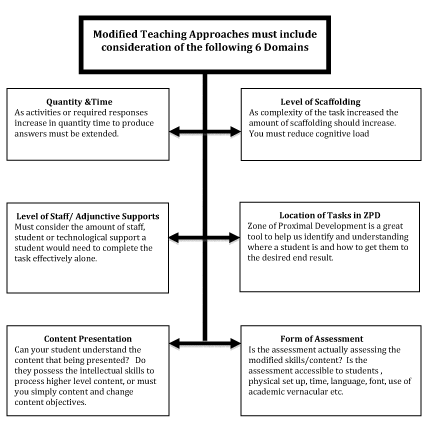
In order to provide sound and appropriate educational instruction the teacher must first consider the following instructional domains: ( these domains are domains by which most all instruction can be broken down into.)
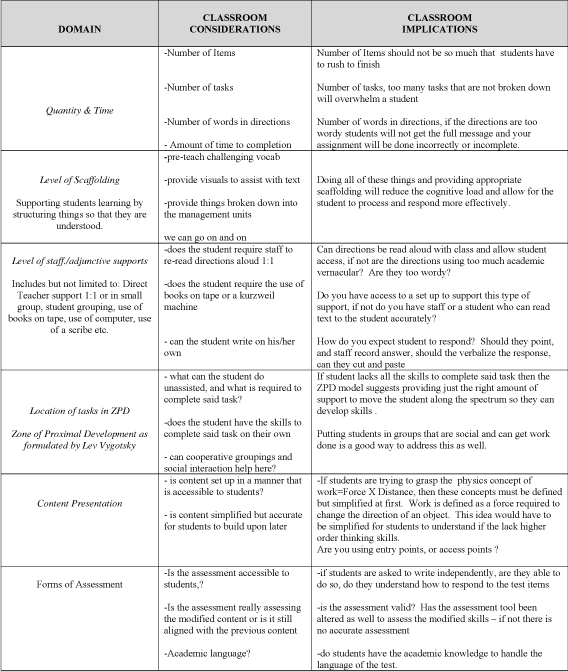
The chart below has been devised based on the training and experience of the author. It provides more contexts for each domain above. The concepts here are considerations the author makes everyday when teaching students with varied abilities, put into a package if you will to help increase the comprehensible input of the readers. Examples in this chart are in no way meant to be all inclusive, nor prescriptive. It is the responsibility of all educators to consider each domain and apply your considerations in a manner consistent with students’ IEPs as well as sound practice.
Conclusion
Effective instructional interventions utilizing educationally appropriate modifications are not only best practice, required by law, and specified in students’ IEPs; it is also the only way by which a student can succeed. It may appear that some of the examples and implications above are very vague, that is because no one student is the same. If SPED teachers and/or Regular Education teachers consider the 6 domains as shown above likely instructional approaches will develop that support student success. Working with students in a classroom that have multiple levels of disabilities and whose functional limitations vary, it is very important to look at each domain for each student, when trying to create effective instruction.
Download Information
To view or print this handout you have the following options:
View or Download PDF Version of “Teaching to the Students’ Abilities” – PDF (Right Click and Choose Save)