
Download a PDF Version of This e-Journal
Table of Contents
Special Education Legal Update 3
Update from the U.S. Department of Education 7
Prevention of Language Deprivation in Deaf/Hard-of-Hearing Children 11
Enhancing Paraprofessional Training to Support IEP Implementation Fidelity in Special Education 15
Acknowledgements 21
Sponsored By
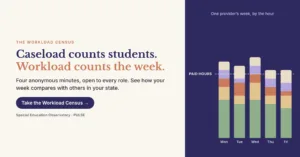
Your week is more than your caseload.
Results are published free, by role and state, for every group of 10 or more educators, so each answer helps your state’s picture come into focus. No name, no school and no student information are asked for.
📊 Add your week to the Census →
You Organize Everyone Else’s Lives. Let Us Help With Yours. 📋
You spend every day keeping IEPs, meetings, and other people’s children organized. Then one phone call puts you in charge of an aging adult’s care with no plan. GrayBrief’s online course gives you the same clear, step-by-step structure you bring to your classroom: Medicare, care options, paperwork, and what to do first.
☎️ Get Organized Before the Call →
Special Education Legal Alert
Perry A. Zirkel
November 2026
This month’s update identifies two recent court decisions that illustrate FAPE issues under the IDEA. For related publications and special supplements, see perryzirkel.com
|
On October 23, 2026, a federal district court in Pennsylvania issued an unofficially published decision in M.C. v. Williamsport Area School District, addressing the first FAPE step for tuition reimbursement of a student with a specific learning disability in reading. In second grade, the district determined that the student was eligible for an IEP under the IDEA. Starting midway in grade 4, his IEP provided for 90 minutes of Wilson Reading Program instruction. In grades 5 and 6, he received this instruction during the English Language Arts (ELA) block. In a series of IEP meetings in grade 6 in preparation for his transition to middle school, the district proposed and the parents reluctantly agreed to a reduction of Wilson instruction to 60 of the 90 minutes in the ELA block in grade 7. The district proceeded with this IEP in grade 7, but the parents reported malfunctions in the speech-to-text software technology. In October, they proposed and the IEP team denied residential placement of the student at the Gow School in New York. In December, the parents provided the district with a 10-day notice maintaining that the IEP did not provide FAPE and that they intended to unilaterally place their child at Gow School and seek reimbursement. Starting in January, they placed their child at Gow. In March, the parents filed for a due process hearing, seeking compensatory education for the alleged denials of FAPE from last part of grade 5 to the middle of grade 7, reimbursement for their Gow placement in the second half of grade 7, and prospective placement at Gow for grade 8. The hearing officer ruled that the ESY programs and the grade 7 IEPs were appropriate except for the implementation of the assistive technology software during the first 6 weeks of the school year. The remedy was limited to 1.5 hours of compensatory education for each of the school days during this 6-week period. The parents appealed. The district counterclaimed only to challenge the compensatory education award. |
|
|
The parents alleged that the hearing officer committed various harmful procedural violations, such as applying various “nonexistent” rules of evidence and refusing to consider their attorney’s reply brief because it was unsolicited and beyond his prescribed page limit. |
Rejecting this claim, the court concluded that none of the hearing officer’s procedural choices beyond the minimum requirements of the IDEA exceeded the flexible discretion accorded to IDEA hearing officers. |
|
The parents also claimed that (a) the IEP did not meet the Endrew F. standard because the district’s reliance on Wilson instruction failed to result in appropriate progress for their child, and (b) the Gow placement was appropriate. |
Disagreeing, the court respectively concluded that (a) methodology was in the district’s discretion, Wilson was peer-reviewed, and the child made sufficient progress, and (b) the Gow placement did not provide FAPE in the LRE. |
|
The district counterclaimed that the IEP’s assistive technology provision was for text-to-speech, not speech–to–text, software. |
The court agreed, thus finding no failure-to-implement denial of FAPE and, thus, reversed the compensatory education award. |
|
This court decision is subject to question for various nuances of its reimbursement analysis, especially for the private placement (e.g., role of LRE and peer-reviewed standard) as alternative rather than integral grounds, but it illustrates the cursory and deferential posture that federal courts sometimes reflect in IDEA cases. |
|
On September 23, 2026, a federal district court in Michigan issued an unofficially published decision in Henke v. East Lansing Public Schools, addressing various FAPE issues for a child with autism and anxiety. Dissatisfied with the use of seclusion and restraint of the child in kindergarten elsewhere, the parents enrolled their child in a district school for grade 1. First, they met with the principal and social worker, who (a) recommended starting with placement in a general education class because most of the children in the autism program were, unlike their child, nonverbal, and (b) promised to try to avoid the use of seclusion. Next, the IEP team met and developed an IEP that provided for a mainstreamed placement with various supports and accommodations, including consultant services, weekly meetings with the social worker, and 25-minute speech and language therapy (SLT) sessions 4–5 times/month. The shortened school day initially ended at 11, with attendance at an applied behavior analysis (ABA) program in the afternoon. The school day was gradually extended to 1 pm by early November, whereupon the schedule of the ABA program no longer was workable. The child’s progress was satisfactory until then. Soon thereafter, however, problems arose including increasingly frequent and extended bathroom breaks to avoid the classroom and culminating in refusal to return to school after the winter break. The parents and staff were able to get him to return for a two-hour school day that devolved into 1:1 services due to issues with other students. Despite continuing amendments to the IEP, his learning regressed along with his behaviors, which included laying on the floor in the main office for long periods; repetitively counting cars in the school parking lot; eloping from service providers and from school; and, in March, incidents of property destruction and assaulting staff members culminating in the brief and unsuccessful use of the school’s seclusion room. After the district did not agree to rule out any future possibility of seclusion and only agreed to trying the autism classroom in the upcoming summer, they withdrew their son and placed him in out-of-state school in grade 2. However, upon its use of seclusion, they moved the child elsewhere. They filed for a due process hearing, which was decided in favor of the district, whereupon they appealed. |
|
|
First, the parents alleged that the district excessively used “seclusion” under Michigan law, including the 1:1 teaching in a separate room. |
Disagreeing, the court concluded that the only use of seclusion was the one brief instance, which met the definition in the Michigan statute and which met that law’s specified emergency exception. |
|
Second, the parents argued that the district kept the child out of general education in violation of the IEP. |
Again disagreeing, the court concluded that the discrepancy from the IEP was limited and even if a violation, it reduced rather than resulted in harm. |
|
Third, they claimed that the district should have placed the student in the autism classroom. |
The court concluded that the choices of deferring placement in the autism classroom during the school year were justifiable in this case. |
|
Fourth, they contended that the district failed to provide all the SLT specified in the IEP. |
The court found that the 5-minute shortfall in the SLT sessions were not a “material” or harmful failure to implement the IEP in this case. |
|
Their various other claims were what the court regarded as procedural forms of FAPE, such as the documentation of progress and the use of a shortened school day. |
Per the two-step analysis for procedural FAPE, the court concluded that even if these actions were violations (step 1), the parents failed to prove the requisite step 2 substantive harm to the child. |
|
This legal outcome is not unusual. Yet, considering the potentially lasting loss to this young child and his parents after two years of costly litigation, one cannot help but wonder about the educational placement choices the district made, the extent of district accountability under the IDEA in relation to parental authority, and the efficacy of the Act’s ponderous process of private enforcement. |
|
Update from the U.S. Department of Education
Birth to Grade 12 Education-Reources
https://www.ed.gov/birth-to-grade-12-education
Available Grants
https://www.ed.gov/grants-and-programs/apply-grant/available-grants
U.S. Department of Education Approves Ohio’s Returning Education to the States Waiver
October 30, 2026
Today, the U.S. Department of Education (the Department) announced another victory for state-driven leadership and innovation by approving Ohio’s Returning Education to the States (RES) Waiver.
October 30, 2026
Today, the U.S. Department of Education’s (the Department’s) Student Privacy Policy Office (SPPO) demanded revisions to the Illinois State Board of Education’s (ISBE) guidance.
October 29, 2026
Today, the U.S. Department of Education finalized a landmark rule to reform, strengthen, and modernize America’s higher education quality assurance system, marking the most significant overhaul of the federal recognition system in decades.
October 28, 2026
Today, the U.S. Secretary of Education Linda McMahon delivered remarks as part of her “The Next 250: American Education” speaking series.
Secretary McMahon Delivers “The Next 250: Higher Education” Remarks at Vanderbilt University
October 28, 2026
Secretary McMahon delivers remarks at Vanderbilt, highlighting the Administration’s efforts to restore excellence in higher education and calling on institutions to renew their commitments to free speech, academic rigor, and the national interests.
October 27, 2026
Today, U.S. Secretary of Education Linda McMahon announced appointments to the National Assessment Governing Board (NAGB).
U.S. Department of Education Celebrates 161 Outstanding Students as 2026 U.S. Presidential Scholars
October 27, 2026
The U.S. Department of Education is proud to announce the selection of 161 exceptional high school seniors as the 2026 U.S. Presidential Scholars, recognizing their remarkable achievements in academics, the arts, and career and technical education.
October 26, 2026
Today, the U.S. Department of Education’s (ED) Student Privacy Policy Office (SPPO) opened investigations into three California school districts for allegedly violating federal parental rights laws.
October 23, 2026
This week, U.S. Secretary of Education Linda McMahon visited Utah and California as stops 47 and 48 on her Returning Education to the States Tour.
October 22, 2026
Today, U.S. Secretary of Education Linda McMahon delivered remarks as part of her “The Next 250: American Education” speaking series.
October 22, 2026
U.S. Secretary of Education Linda McMahon delivers remarks at Arizona State University in Tempe, Arizona, to highlight the Trump Administration’s unprecedented progress in making higher education more affordable, transparent, and accountable.
U.S. Department of Education Approves Workforce Pell Grant Program in Arizona
October 22, 2026
Today, the U.S. Department of Education (the Department) approved a new Workforce Pell Grant Program in Arizona, marking the seventh state in the nation to receive a program approval.
October 21, 2026
Today, U.S. Secretary of Education Linda McMahon delivered remarks as part of her “The Next 250: American Education” speaking series.
October 21, 2026
Secretary McMahon delivers remarks at the College of Southern Nevada in Las Vegas, Nevada, to highlight the Trump Administration’s unprecedented progress in expanding workforce pathways and preparing Americans for in-demand careers.
October 20, 2026
Today, U.S. Secretary of Education Linda McMahon delivered remarks as part of her “The Next 250: American Education” speaking series.
October 20, 2026
U.S. Secretary of Education Linda McMahon delivered remarks at American Preparatory Academy in Salt Lake City, Utah to highlight the Trump Administration’s unprecedented progress in restoring excellence in K-12 education.
October 19, 2026
Today, U.S. Secretary of Education Linda McMahon visited Washington as the 46th stop on her Returning Education to the States Tour.
October 15, 2026
Today, U.S. Secretary of Education Linda McMahon visited New Hampshire as part of her Returning Education to the States Tour.
U.S. Secretary of Education Linda McMahon Visits Minnesota on Returning Education to the States Tour
October 14, 2026
Today, U.S. Secretary of Education Linda McMahon visited Minnesota as part of her Returning Education to the States Tour.
October 7, 2026
On the third anniversary of the brutal attack on Israel, the U.S. Department of Education’s Office for Civil Rights (OCR) is expanding its investigation into Swarthmore College.
October 6, 2026
As part of its nationwide initiative to crack down on “Pass the Trash” practices, the U.S. Department of Education’s Office for Civil Rights (OCR) today opened investigations…
October 5, 2026
With the close of Fiscal Year (FY) 2026, the U.S. Department of Education (ED) continued to deliver on its promise both to supercharge evidence-based literacy and the fundamentals of learning.
October 5, 2026
Today, the U.S. Department of Education (ED) and the U.S. Department of Justice (DOJ) sent a joint letter to all state Attorneys General reaffirming the Trump Administration’s commitment to protecting parental rights.
Prevention of Language Deprivation in Deaf/Hard-of-Hearing Children
By Jamie B. Ferreira
Prevention of Language Deprivation in Deaf/Hard-of-Hearing Children
Deaf or Hard-of-Hearing (DHH) children are born to hearing parents more than ninety percent of the time. Babies are tested just after birth to determine if a hearing loss is present. Should a hearing loss be detected, parents are then urged to avoid sign language and use hearing devices immediately. Access to language is focused strictly on auditory and oral methods. Hearing devices, such as Cochlear Implants, often fail due to limited amounts of speech therapy required for the child to learn to hear. This causes the child to lack accessible language exposure.
Language Deprivation is more than a lack of a full and complex language, auditory or visual. Not having access to language from birth to age five will cause the child issues with linguistic competency and cognitive functioning, up to and including memory, organization, and ability to easily excel in the educational setting (Humphries et al., 2012). In addition, the child often feels isolated due to the inability to understand others and be understood by others. This issue has quickly become an epidemic that is easily prevented.
Early access to a visual language
The younger a child is presented with an accessible language, the more fully they can navigate the appropriate use of that language (Cheng & Mayberry, 2019). Access to a visual language, such as American Sign Language (ASL), during the early years of life provides the child opportunity to develop a full and complete language. While there is some thinking that if a child is exposed to ASL, they will not learn to speak. This has been proven false. The use of ASL used alongside English, supports the development of speech (Humphries et al., 2024). Providing a language rich environment at home provides the child increased success in school. Fluency in a visual language, like ASL, allows the child to fully access and comprehend their education presented in that language (Humphries et al., 2024). In addition to preparing their child for educational success, when a child is surrounded by a fully functioning language, they are more likely to develop strong bonds with their parents or caretakers. Lillo-Martin et al. (2023) recommend the use of a deaf adult to provide ASL exposure to the entire family. Allen & Morere found through their research that the earlier children were exposed to language, the higher their literacy skills (2020).
Bi-model Education
Paring ASL with written or spoken English will afford the DHH child the opportunity to learn both languages fluently. Intense exposure to vocabulary, both in a sign and written format, is essential. Start by labeling your classroom with the written word for the item, as well as a picture of the sign. Easterbrooks et al., note that stories can also assist with vocabulary instruction (2025). Pairing stories with other activities can support learning various words. Students with a hearing loss require direct, explicit instruction and multiple exposures to concepts. Far more exposures than the average hearing child. Providing opportunities to pair the concepts with real world examples will advance understanding (Easterbrooks et al., 2025). Doing so allows the child to generalize concepts taught in isolation.
Easterbrooks et al. suggests that DHH students are explicitly taught at least five new vocabulary terms each week (2025). These should be taught in a variety of ways and based on their age level. Continue by pairing words together so that the child’s utterances begin to lengthen. As mentioned before, reiteration is key. Provide multiple opportunities for the child to be presented with the story, vocabulary and definitions. This will ensure retention of the concept.
Phonetic awareness is an aspect of language acquisition that children with a hearing loss are either unable to do or struggle with. There has been success with bridging that gap by using Visual Phonics (Easterbrooks et al., 2025). Visual Phonics takes what is auditory and provides a visual representation. Visual Phonics can be used with sign language because ASL does not have a phonological component. Visual Phonics can be implemented with learning the alphabet to represent the sounds that corresponds to each letter.
Conclusion
Language acquisition is paramount to all of life’s functions. From education to personal connection, nothing occurs without language. Language learning starts from birth. The earlier one is exposed to an accessible language, the more fluent one becomes in that language. Even if a child with a hearing loss is using a hearing device like a Cochlear implant, supplementing with a visual language will aid in the child’s fluency. Presenting information visually and auditorily will increase the child’s ability to access their education. Providing DHH children with language rich environments will set them up for ease in the educational setting. Multiple exposures to concepts in multiple modes will ensure the child fully grasps concepts being taught. All of these evidence-based practices will work in tandem to provide the DHH child with the interventions required to become successful students.
References
Allen, T. E., & Morere, D. A. (2020). Early visual language skills affect the trajectory of literacy gains over a three-year period of time for preschool aged deaf children who experience signing in the home. PLoS ONE, 15(2), Article e0229591. https://doi.org/10.1371/journal.pone.0229591
Cheng, Q., & Mayberry, R. I. (2019). Acquiring a first language in adolescence: The case of basic word order in American Sign Language. Journal of Child Language, 46(2), 214 240. https://doi.org/10.1017/S0305000918000417
Easterbrooks, S., Lederber, A. R., Schick, B., Bridenbaugh, N., & Rivera, M. C. Evidenced-Based Language and Literacy Interventions. Communication Interventions with Deaf People (Oxford, 2025; online edn, Oxford Academic, 29 May 2025), https://doi.org/10.1093/9780191983726.003.0021
Humphries, T., Kushalnagar, P., Mathur, G. et al. Language acquisition for deaf children: Reducing the harms of zero tolerance to the use of alternative approaches. Harm Reduct J 9, 16 (2012). https://doi.org/10.1186/1477-7517-9-16
Humphries, T., Mathur, G., Napoli, D.J. et al. An approach designed to fail deaf children and their parents and how to change it. Harm Reduct J 21, 132 (2024). https://doi.org/10.1186/s12954-024-01039-1
Lillo-Martin, D. C., Gale, E., & Pichler, D. C. (2023). Family ASL: An Early Start to Equitable Education for Deaf Children. Topics in early childhood special education, 43(2), 156–166. https://doi.org/10.1177/02711214211031307
Enhancing Paraprofessional Training to Support IEP Implementation Fidelity in Special Education
By Camryn Ellison
Introduction
The role of a paraprofessional has seen many changes since its inception in the education field. In the mid-1950s, the government created the paraprofessional position in response to a national shortage of special education teachers. Since then, there has been significant growth in the need for their support in classrooms. What was formerly a role supporting special education teachers with clerical tasks and assigned duties is now a crucial position encompassing instructional support, IEP implementation, and more.
Paraprofessional duties vary depending on the student population and instructional assignment, such as one-on-one, classroom-based, or student-focused. However, most assist students with personal care, support classroom instruction through lesson reinforcement and small-group facilitation, manage behavior, and perform clerical tasks. Additionally, paraprofessionals support the implementation of students’ IEPs, collaborating with special education teachers to design daily lessons, activities, and routines to meet specific student goals. Paraprofessionals work directly with students under the teacher’s guidance, making their role integral to classroom success.
Proper training is essential to ensure that paraprofessionals support student learning experiences successfully and safely. Research shows that most paraprofessionals have not pursued higher education related to education or special education or worked in a relevant field prior to becoming a paraprofessional (Irvin et al., 2017). In many districts, most complete the required training, which typically includes mandated reporting, HR procedures, and other general teacher training, often delivered online. Very rarely are paraprofessionals required to engage in training specific to their role that addresses potential medical needs or the educational needs of students. There are currently no standardized training or supervision requirements to ensure consistent practices across schools. The lack of professional development directly impacts the effectiveness of the paraprofessional, and research indicates a significant gap. It is important to examine the need for paraprofessional training because it directly impacts the fidelity of IEP implementation and student outcomes.
Literature Review
Existing research highlights gaps in paraprofessional training, the need to support teacher-paraprofessional collaboration, effective training models and strategies for paraprofessionals, modes of supervision for paraprofessionals and teachers, and the need for more quantitative research that assesses these outcomes by evaluating the impact these methods have on special education students.
To begin, research reveals significant gaps in effective training strategies for paraprofessionals. Many paraprofessionals continue to lack appropriate preparation despite engaging daily in essential instructional responsibilities (IDEA Partnerships, 2001; Chopra et al., 2004, as cited in Hughes & Valle-Riestra, 2008). As their responsibilities increase, ensuring that paraprofessionals are adequately trained and supported is crucial. Many school districts rely on large-group training sessions to prepare paraprofessionals (Giangreco et al., 2010, as cited in Mason et al., 2017). While these sessions provide valuable information, follow-up to ensure application of training content with fidelity is often minimal (Simonsen et al., 2008, as cited in Mason et al., 2017). Furthermore, most teacher preparation programs and higher education institutions do not adequately prepare teachers to supervise or train other adults. Research also indicates that few teachers have access to paraprofessionals who have received specialized training (Lerman et al., 2020). Collectively, these findings highlight a critical gap in paraprofessional training and underscore the need to equip teachers with evidence-based strategies to support and coach paraprofessionals effectively.
Next, researchers examined a variety of instructional models, such as web-based instruction, pyramidal training, practice-based coaching (PBC), and behavioral skills training (BST), to evaluate their impact on paraprofessional performance and the fidelity of their implementation for students with disabilities. Across studies, paraprofessionals participated in collaborative training sessions with special education teachers. They completed baseline assessments and received coaching on specific instructional or behavioral strategies, after which their performance was observed and evaluated. The paraprofessionals selected some target skills, while researchers or teachers assigned others. Structured coaching and teacher-led training models strengthen paraprofessional competence, collaboration, and instructional fidelity (Mason et al., 2017; Lerman et al., 2020). Web-based and pyramidal models can provide scalable solutions but may lack individualized follow-up. BST and PBC approaches show promise in ensuring skills are applied with fidelity.
Lastly, effective collaboration hinges on communication, supervision, and role clarity (Barnes et al., 2021; Irvin et al., 2018). Teacher coaching directly impacts paraprofessional growth and student outcomes by modeling effective instructional strategies, providing structured feedback to reinforce skills, and supporting paraprofessionals in navigating students’ behavioral, medical, and academic challenges.
Conclusion
Based on these findings, consistent themes emerged: paraprofessionals’ roles are essential; collaboration with teachers is important; paraprofessionals learn best with immediate feedback and coaching sessions; web-based modules provide foundational knowledge that can support practice-based feedback; and pyramidal training is practical. In summary, it is imperative to continue researching paraprofessional training and its impact on students. These studies collectively tell us that paraprofessional training is beneficial for preparing paraprofessionals and that preparation for implementation, with the teacher’s collaboration, is important. The most effective model is practice-based coaching (PBC). Given the straightforward and focused nature of PBC, it is plausible that PBC alone may yield desired outcomes, further increasing the utility of providing training to paras (Mason et al., 2017).
Understanding that most paraprofessionals enter the field with limited experience and training and some are rarely provided with the opportunity to engage in continuous training, as most training is on-the-job (Hughes & Valle-Riestra, 2008), these findings help deepen our understanding of the challenges paraprofessionals may face in implementing IEPs with fidelity and the methods that could improve this task.
School districts, administrators, and teachers can apply these findings to improve paraprofessional training by providing teachers with training on how to train paraprofessionals and equipping them with the knowledge to teach and lead them. Additionally, districts and administrators could add a criterion for observations that includes a rubric that grades teachers and paraprofessionals on this topic. While the existing research provides valuable insights, limitations exist due to small sample sizes, short-term designs, limited experiments across varying disabilities, and limited discussion of student findings. Future research should include a more diverse participant group and integrate quantitative measures of student outcomes. There should also be more exploration on teacher and paraprofessional collaborations and the systematic supports needed to maintain partnerships that will improve special education service delivery.
References
Barnes, T. N., Cipriano, C., & Xia, Y. (2021). Cultivating effective teacher–paraprofessional collaboration in the self-contained classroom. Beyond Behavior, 30(2), 107. https://doi.org/10.1177/10742956211021858
Coogle, C. G., Walker, V. L., Ottley, J., Allan, D., & Irwin, D. (2022). Paraprofessionals’ perceived skills and needs in supporting students with autism spectrum disorder. Focus on Autism and Other Developmental Disabilities, 37(4), 227. https://doi.org/10.1177/10883576211073699
Douglas, S. N., Uitto, D. J., Reinfelds, C. L., & D’Agostino, S. (2019). A systematic review of paraprofessional training materials. The Journal of Special Education, 52(4), 195–207. https://doi.org/10.1177/0022466918771707
Hughes, M. T., & Valle-Riestra, D. (2008). Responsibilities, preparedness, and job satisfaction of paraprofessionals: Working with young children with disabilities. International Journal of Early Years Education, 16(2), 163–173. https://doi.org/10.1080/09669760701516892
Irvin, D. W., Ingram, P., Huffman, J., Mason, R., & Wills, H. (2018). Exploring paraprofessional and classroom factors affecting teacher supervision. Research in Developmental Disabilities, 73, 106–114. https://doi.org/10.1016/j.ridd.2017.12.013
Lerman, D. C., Luck, K. M., Smothermon, S., Zey, B. A., Custer, T., & Smith, L. D. (2020). Training of paraprofessionals by their classroom teachers: A descriptive evaluation of pyramidal training outcomes. Journal of Behavioral Education, 29(4), 675–698. https://doi.org/10.1007/s10864-019-09341-w
Mason, R. A., Schnitz, A. G., Wills, H. P., Rosenbloom, R., Kamps, D. M., & Bast, D. (2017). Impact of a teacher-as-coach model: Improving paraprofessionals’ fidelity of implementation of discrete trial training for students with moderate-to-severe developmental disabilities. Journal of Autism and Developmental Disorders, 47(6), 1696–1707. https://doi.org/10.1007/s10803-017-3086-4
Acknowledgements
Portions of this or previous month’s NASET’s Special Educator e-Journal were excerpted from:
- Center for Parent Information and Resources
- Committee on Education and the Workforce
- FirstGov.gov-The Official U.S. Government Web Portal
- Journal of the American Academy of Special Education Professionals (JAASEP)
- National Collaborative on Workforce and Disability for Youth
- National Institute of Health
- National Organization on Disability
- Substance Abuse and Mental Health Services Administration
- U.S. Department of Education
- U.S. Department of Education-The Achiever
- U.S. Department of Education-The Education Innovator
- U.S. Department of Health and Human Services
- U.S. Department of Labor
- U.S. Food and Drug Administration
- U.S. Office of Special Education
The National Association of Special Education Teachers (NASET) thanks all of the above for the information provided for this or prior editions of the Special Educator e-Journal
Sarah S. Ayala, LSU | Associate Editor, NASET e-Journal