
Every unfilled special education position is not just an empty desk, it is a student with an IEP whose legally guaranteed services are quietly disappearing. Across the country, the special education teacher shortage has moved well past a staffing inconvenience. It has become a structural crisis—one with legal consequences, ethical landmines, and a professional dignity problem severe enough to drive experienced teachers out the door faster than new ones can enter.
The numbers are stark. More than 40 states report shortages of special education teachers as a critical need. Students are being assigned to unqualified substitutes, caseloads are ballooning past reasonable limits, and compliance is eroding in silence. This is not a pipeline problem with a tidy certification fix. It is a system under pressure from every direction at once—and the teachers who stay are absorbing the damage.
When Understaffing Becomes a Civil Rights Problem

The shortage has crossed a threshold most administrators haven’t publicly acknowledged: it is now a federal civil rights issue.
The Office for Civil Rights (OCR) is actively intervening in school districts where IEP failures trace back to understaffing. Districts that cannot staff IEP meetings, deliver mandated services, or maintain compliant documentation are being held legally accountable—not just given a warning. The U.S. Department of Education’s IEP guide makes clear that IEPs are legal documents carrying enforceable obligations. When a district is short three special education positions, those obligations do not pause.
What makes this worse is the retaliation problem. Special education teachers who flag compliance violations—missing services, improper placements, skipped evaluations—have reported professional consequences for doing so. That is not a coincidence. When systems are overwhelmed, whistleblowers become threats rather than allies. The result is a culture of silence inside the very institutions legally required to protect students with disabilities.
This is the feedback loop. Understaffing creates compliance failures. Compliance failures create legal risk. Legal risk creates institutional self-protection. And institutional self-protection punishes the teachers most committed to doing the job correctly.
The Administrative Burden Breaking the Special Education Teacher

Caseload size is the crisis beneath the crisis.
A special education teacher managing twenty or more students isn’t spending most of her time teaching. She’s writing IEPs, drafting progress notes, scheduling meetings, documenting accommodations, and communicating with families—all of it legally required, none of it optional. In many districts, she’s doing this with inadequate support, little planning time, and zero administrative backup.
AI tools are beginning to appear as a stopgap. Some teachers are using AI to draft IEP language, generate progress report templates, or streamline documentation workflows. That is a reasonable response to an unreasonable situation. But the field has almost no formal guidance on how to use these tools ethically, accurately, or in compliance with FERPA and IDEA requirements. Teachers are making independent judgment calls about student data and privacy without institutional guardrails in place.
If you’re exploring how to navigate the administrative weight of this role with greater structure and confidence, NASET’s professional development course Roles and Responsibilities of the Special Education Teacher covers the full scope of what the job actually demands, including documentation obligations that don’t appear in any job description.
The risk here is real. An AI-generated IEP goal that doesn’t meet legal standards, or a document produced using a student’s identifiable data in an unsecured tool, could expose a teacher to liability she was already too exhausted to consider. Good intentions are not a compliance defense.
The Gap Between Recognition and Reality for Special Education Teachers
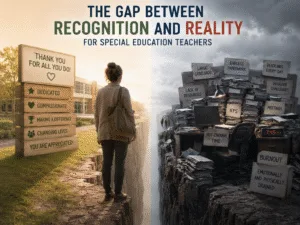
Professional organizations are not ignoring this crisis. The National Association of Special Education Teachers (NASET) has expanded recognition programs celebrating excellence in the field. On one level, that matters, visibility and acknowledgment are not nothing when a profession feels invisible.
But there is a growing cynicism among practicing special education teachers and case managers, and it deserves an honest look.
When a teacher is managing 24 IEPs, fielding compliance complaints, and covering for two unfilled positions in her building, an award ceremony feels distant. Recognition without relief starts to feel like institutional theater. The gap between what organizations celebrate and what teachers survive on a Tuesday afternoon is wide enough to breed resentment… and resentment accelerates exits.
This is not an argument against recognition. It is an argument for pairing recognition with structural advocacy. Professional organizations carry weight with legislators, state education agencies, and accreditation bodies. That influence should be aimed at caseload caps, compensation reform, and burnout intervention, not as an either/or with celebration, but alongside it.
For teachers navigating state-by-state differences in requirements, caseload expectations, and compensation, NASET’s complete state-by-state guide to special education teacher requirements and salaries is one of the more practical tools available for understanding what you’re legally entitled to and where advocacy levers exist.
The Feedback Loop Nobody Wants to Name
Here is the honest summary of where things stand.
The shortage creates overload. Overload creates burnout. Burnout drives exits. Exits deepen the shortage. Meanwhile, compliance failures accumulate, legal risk rises, and the teachers who remain absorb increasingly unbearable conditions. New teachers enter this environment, assess it honestly, and leave faster than retention strategies can hold them.
Nothing about this is inevitable—but nothing about it will resolve without naming it plainly.
Districts need to confront caseload caps as a legal and ethical threshold, not a budget negotiation. State agencies need to treat special education positions as a compliance priority rather than an HR gap. Professional organizations need to use their platforms to push structural reform alongside recognition. And teachers who are building cases for change: within their buildings, their unions, or their districts, need tools that help them do that effectively.
NASET’s resources on building your case as a special education professional offer a grounded framework for navigating those difficult advocacy conversations.
Conclusion: This System Needs More Than Sympathy
The special education teacher shortage is not a story about empty positions. It is a story about students losing access to legal protections, teachers absorbing structural failures, and a profession being quietly hollowed out while institutions celebrate its best moments.
Three things are true right now. First, the shortage has federal civil rights implications, and teachers caught in it need to understand that. Second, AI tools may reduce administrative burden, but they require ethical frameworks the field has not yet developed. Third, recognition without structural relief is not enough.
If you’re a special education teacher or case manager working to build your professional foundation, grow your skills, or navigate the demands of this role with greater clarity, explore the full range of professional development courses and resources available through NASET’s online learning store. The courses there are built for practitioners in the real world, not an idealized version of it.