

There is a child sitting in an IEP meeting right now who deserves more than what is being offered. Their parent doesn’t know what questions to ask. The school district’s attorney is in the room. And the team is moving fast toward a placement decision that may follow this child for years.
What that room is missing is a special education advocate.
Special education advocacy is one of the fastest-growing, most meaningful, and most undercredentialed professions in the entire education ecosystem. Demand is exploding. Credentials are scarce. And the special education advocate professionals who step into this space with real training and a real business behind them are building careers that are both financially rewarding and genuinely transformative.
The History Behind the Role: Born in the Courts, Built on Necessity

The role of the special education advocate did not begin in a classroom. It began in the courts.
Before federal law intervened, children with disabilities were routinely excluded from public education entirely. The civil rights movement provided the legal framework that changed this. Brown v. Board of Education established that separate is not equal, and that precedent carried directly into landmark cases including PARC v. Pennsylvania (1972) and Mills v. D.C. (1972), which legally established the right to a Free Appropriate Public Education for students with disabilities.
Over fifty years ago, the Education for All Handicapped Children Act of 1975 was the first federal law to mandate Individualized Education Programs (NASET marked the occasion by hosting a webinar with Ed. W. Martin, one of the law’s original co-authors on IDEA’s 50th anniversary). As that law evolved into the Individuals with Disabilities Education Act in 1990 and again in 2004, the complexity of IEPs and procedural requirements created a widening knowledge gap between what schools knew and what most parents could navigate alone. Advocates emerged to close that gap.
Today, with over 8 million students served under IDEA and a compliance crisis in the majority of states, that gap is wider than ever. NASET’s BCASE exists to produce the professionals qualified to close it.
Why Demand for Special Education Advocates Has Never Been Higher

The numbers make the case on their own.
According to the National Center for Education Statistics, the number of students ages 3-21 receiving special education services rose from 6.4 million in 2012-13 to 7.5 million in 2022-23, representing approximately 15% of all public school students.
In 2024, that number climbed further to an estimated 8.19 million IDEA-eligible students, representing a 3.8% year-over-year increase and the highest enrollment in U.S. history. The largest growth is concentrated in autism, multiple disabilities, and developmental delay – the classifications that require the most sophisticated advocacy.
That is 8 million children with a legal right to individualized services. Millions of families navigating a system designed by lawyers and administered by school districts with their own legal counsel.
And here is the part that should concern every parent and motivate every aspiring advocate: as of 2025, less than half of school-age students with disabilities are educated in states that received a “Meets Requirements” determination from the Department of Education. The majority of students are in systems that are struggling to follow federal law. The compliance gap is not a footnote. It is the entire reason this profession exists.
The advocacy profession itself has no licensure requirement. There is no national licensing body, no government-mandated oversight, no bar exam. Any person can call themselves a special education advocate tomorrow with no training, no credential, and no accountability.
This creates an obvious problem for families and an unmistakable opportunity for professionals who take their preparation seriously.
What Does a Special Education Advocate Actually Do?

The day-to-day work of an advocate spans three broad skill sets, and a genuinely effective advocate must be strong in all three.
Legal knowledge is the foundation. Advocates must understand IDEA inside and out – FAPE, LRE, evaluation timelines, procedural safeguards, resolution sessions, due process hearings, and state-specific implementation. They need to know what a school district is legally required to do and, critically, what it is not required to do. They must understand the “Reasonably Calculated” standard from the 2017 Supreme Court ruling in Endrew F. v. Douglas County School District without hesitation, because schools and their attorneys certainly do.
One NASET BCASE certification holder put it plainly: “Your program showed me what I should have learned. It connected IDEA to what it looks like in action.” Another said: “Nobody really tackles the practical side of special ed law and IDEA the way your program does.“
Assessment literacy is what separates good advocates from great ones. Psychoeducational evaluations, speech and language assessments, occupational therapy reports – these documents drive eligibility and placement decisions, and most parents cannot read them. Peer-reviewed research published in JAASEP has examined this problem directly: a 2025 study titled “The Best Kept Secret: Readability and Accessibility of IEPs” documented that IEP documents are not accessible or readable to most families – precisely the gap a trained advocate is equipped to close. An advocate who can decode standard scores, interpret percentile rankings, identify evaluation gaps, and challenge inadequate assessments is worth their fee many times over.
Communication and negotiation are the tools that make everything else work in practice. The best advocates understand that IEP meetings are not courtrooms. The goal is a better outcome for the child, and that outcome is usually more achievable through skilled negotiation than through an adversarial posture. Facilitated IEP meetings, collaborative problem-solving, and early dispute resolution are the preferred path – with due process as the escalation, not the default.
Research consistently shows that families from racially and ethnically diverse backgrounds face compounded barriers in navigating special education systems – making the presence of a trained advocate even more consequential.
What Do Special Education Advocates Earn?

This is the question that stops most people who are curious about the career, and the answer is better than most expect.
Most special education advocates charge an hourly rate ranging from $150 to $300 or more depending on region, or a flat fee for specific meetings or IEP reviews. Families seeking comprehensive annual IEP support can expect to invest anywhere from $1,500 to over $3,000 depending on the complexity of their child’s case and the advocate’s experience level.
Earning potential is highest in densely populated states with active special education litigation – particularly California, New York, and New Jersey.
Independent advocates who build strong reputations, referral networks, and systemized practices routinely break six figures. The ceiling is high. But the floor depends almost entirely on how seriously you build the business side of your practice – which is a separate skill set from advocacy itself, and one most training programs skip entirely.
The Red Flags Families Should Watch For (And That Credentialed Advocates Would Never Do)

The absence of licensing requirements in this field means families are vulnerable to bad actors, and some of them are very good at sounding credible.
Here is what to watch for.
If someone promises you a specific outcome, walk away. No advocate, no matter how experienced, can guarantee what a school district will agree to. Legal and administrative processes do not work that way. Anyone who tells you “I’ll get your child into that program” or “I guarantee we win at due process” is either uninformed or lying. Either way, they are not someone you want in that meeting.
If someone says “you only pay me if we win” – that’s a contingency fee structure, and it is prohibited for advocates. Contingency billing means the advocate takes a percentage of whatever they “win” for you, like a personal injury lawyer. It sounds appealing. It is also a red flag, because it means their incentives may not align with what is actually best for your child. Credentialed advocates charge flat fees or hourly rates. Full stop.
If someone cannot explain the Endrew F. standard, they are not ready for your IEP table. In 2017 the Supreme Court ruled in Endrew F. v. Douglas County School District that schools must offer programs “reasonably calculated to enable a child to make progress appropriate in light of the child’s circumstances.” This is the legal benchmark that governs what “appropriate” actually means. If an advocate looks at you blankly when you mention it, so will the school district’s attorney. Research published in JAASEP’s Fall 2025 issue, “IEP Quality in Focus: Legal, Research, and Practical Perspectives,” reflects just how actively this legal terrain is being studied and contested at the highest levels of the field.
And if someone promises you a perfect IEP for $5,000 upfront? Run, don’t walk.
The solution is simple: work only with advocates who hold recognized credentials. For advocates reading this, the implication is equally clear – in a profession without entry standards, your credential is not just a resume line. It is the entire reason a family should trust you over the next person who calls themselves an advocate.
How NASET’s BCASE Sets the Standard
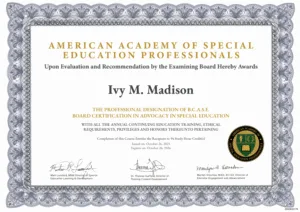
The National Association of Special Education Teachers (NASET) has spent over 22 years building the most comprehensive professional development infrastructure in special education. The Board Certification in Advocacy for Special Education (BCASE) is NASET’s answer to the professionalization gap in this field.
One BCASE certification holder said it directly: “I found NASET on Google and thought, is this real? You’re such a niche. There’s nobody else doing it.”
That observation is accurate. There is no other organization offering a board-certified credential in special education advocacy with this depth of curriculum.
The BCASE is comprised of 30 units of study across 6 comprehensive modules, totaling 94 study hour credits. Each unit includes video lectures, PowerPoint presentations, supplemental videos, and supplemental readings. Modules must be completed in sequence, and each concludes with a multiple-choice examination requiring a minimum score of 80% to advance. Upon completing each module, candidates receive a digital certificate of recognition. Upon completing the full program, they receive a hard copy board certification certificate. Many states and districts have rigorously reviewed our BCASE certification and approved it for continuing education and professional development as well.
The six modules cover:
Module 1 – Overview of Legal Issues in Special Education. FAPE, IDEA, IEPs, related services, LRE, extended school year services, and the Endrew F. standard – covered with the depth they require in actual practice.
Module 2 – Assessment in Special Education. Methods of assessment, evaluation statistics, scoring terminology, and the identification and classification process for students with disabilities. This is the module that turns an advocate into someone who can read an evaluation report and know exactly what questions to ask – closing the exact readability gap that JAASEP research has documented.
Modules 3 and 4 – Understanding Students with Exceptionalities. Candidates develop comprehensive knowledge of the full range of disability categories served under IDEA. Five categories alone – learning disabilities, speech and language impairments, other health impairments, autism, and intellectual disabilities – account for 83% of all students receiving special education services. You cannot advocate for a child you do not understand.
Module 5 – Procedural and Ethical Issues. Confidentiality, FERPA, ethical obligations, and professional conduct. The rules that govern how advocates operate and the legal boundaries they must never cross.
Module 6 – Dispute Resolution. Resolution meetings, mediation, due process hearings. The escalation pathway every advocate must know and most families hope they never need.
The Part Nobody Talks About: Running the Business

Here is the honest truth that most advocacy training programs skip entirely: you can be the most knowledgeable advocate in your state and still fail if you do not know how to run a business.
Client intake. Fee structures. Legal business entities. Managing difficult client relationships. Marketing yourself to families, school districts, and referral sources. Setting financial projections and actually hitting them. These are not soft skills. They are the operational infrastructure that determines whether your advocacy practice thrives or quietly folds.
One BCASE Business Certificate holder was direct: “It was a low-cost investment and I got so much out of it.“
NASET built the BCASE Business Certificate specifically to address the business gap. At 15 study hour credits, it covers the business of advocacy from the ground up:
- Creating a full business plan as a special education advocate, including a step-by-step walkthrough of an actual sample plan
- Choosing a legal structure – sole proprietorship, general partnership, limited partnership, or professional corporation – and understanding the tax and liability implications of each
- Client intake and the initial parent meeting, including how to gather information, set expectations, and establish a strong working relationship from day one
- Fee structures, billing practices, and handling non-payment
- Marketing your practice and building referral networks
- Managing difficult client situations – and knowing when to end a client relationship
This is not supplemental content. It is the difference between someone who knows advocacy and someone who builds a lasting career in it.
Enroll in the BCASE Business Certificate Today!
The Financial Reality: Certifications That Pay for Themselves

It is worth pausing on something that NASET certification holders report consistently, because it changes the math entirely.
One BCSE certification holder shared: “I submitted my coursework for reimbursement and HR said, you get a salary increase for board certification. I had no idea.”
Another reported: “I ended up with a stipend of about $2,000 to $2,500 for having a board certification.”
And a third said simply: “I made my money back and then some.”
These are not outliers. Districts routinely fund professional development for staff, and NASET board certification is widely recognized as qualifying for reimbursement and salary advancement. For someone building an independent advocacy practice, the credential signals to every prospective client exactly what separates you from the uncredentialed alternatives.
The Case for Doing Both

NASET designed these two credentials to work together because the field requires both. The BCASE gives you the clinical and legal depth to walk into any IEP meeting, evaluation review, or due process hearing and perform at the highest level. The Business Certificate gives you the operational foundation to build a practice that is financially sustainable, professionally managed, and positioned to grow.
There are people in this field who have deep legal knowledge and no idea how to run a business. There are others who are excellent at client relationships and marketing but are not equipped to challenge a flawed psychoeducational evaluation. Neither is enough.
The advocates who will define this profession as it professionalizes – driven by 8 million IDEA-eligible students, a compliance crisis in the majority of states, and families who are increasingly sophisticated about their rights – are the ones who show up with both.
As one veteran special education teacher told NASET: “I’d been teaching 15 to 20 years and still couldn’t find specialized training that actually helped in special ed. NASET was the first thing that truly fit.”
That combination starts here.
Board Certification in Advocacy for Special Education (BCASE) – 94 study hour credits
Enroll Today!
BCASE Business Certificate – 15 study hour credits
Enroll Today!
NASET has been the leading professional organization for special education teachers for over 22 years. Learn more at naset.com. NASET also operates the independently peer-reviewed academic journal, The Journal of the American Academy of Special Education Professionals. Learn more at aasep.org