
Teaching special education is one of the most meaningful and demanding jobs in any school. You navigate complex student needs, detailed legal requirements, and high-stakes decisions every single day. Now, classroom cameras are being added to that list, and the policy debate behind them is moving fast.
Whether a camera protects you or puts you at risk may depend on what you do right now. New law state mandates are moving through legislatures while parents, teachers, and advocates push back in real time. This is not a distant concern. It is happening now, and special education teachers are caught in the middle.
Why Cameras in Special Education Classrooms Are a Live Policy Fight
This story is moving across multiple outlets at once. Within a 48-hour window, EdSurge, Yahoo News, and KLFY all published coverage of the same unfolding debate. That kind of simultaneous attention signals something: this issue has reached a tipping point.
Louisiana is already ahead of most states. It requires cameras in certain special education settings under state law, and local advocates and legislators are actively debating how far that mandate should go. Texas is not far behind, with similar conversations gaining traction among lawmakers and school boards weighing camera requirements in special education classrooms.
The tension driving all of this is real on both sides. Parents want accountability. In some cases, they have seen what happens without it. A widely shared post on r/Teachers about a Richmond School District incident, in which a five-year-old autistic girl was subjected to an unauthorized exam by a school employee, put the stakes into plain view. Incidents like that fuel the parent-side demand for cameras, and that demand is not going away.
At the same time, special education teachers have legitimate fears of their own. Being recorded without proper context, policy, or protections is not accountability. It is exposure.
Special Education Law and Camera Policies Do Not Always Align
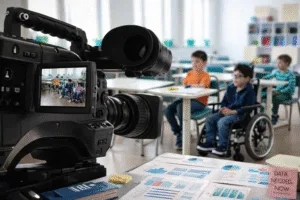
This is where things get complicated. Special education teachers already work within overlapping legal frameworks. IDEA, Section 504, and FERPA all shape what student information can be shared and who can access it.
Footage from a special education classroom is not neutral video. It may show a student’s behavioral support plan in action, a sensory accommodation, or a crisis de-escalation moment. Understanding what every special education teacher should know about student behavior plans makes it clear just how much professional judgment goes into each of those moments. A camera captures behavior, but it cannot explain the legal and educational context behind it. That gap is where things go wrong for teachers.
A completed sample IEP also shows just how much sensitive, layered information surrounds one student’s educational experience. Any footage could reveal a student’s disability status or IEP details to someone reviewing it without proper training.
Your district’s camera policy may not yet have clear answers to these questions:
- Who can review the footage?
- How long is it stored?
- Can a parent request it under FERPA?
- Can it be subpoenaed in a dispute?
If your district has not answered these questions in writing, that is a gap that puts you at risk.
The Support System for Special Education Teachers Is Under Pressure
This challenge would be hard enough in a well-resourced school system. But special education is operating under real strain right now. Funding pressures, growing caseloads, and uncertainty around federal IDEA protections have made the support structure thinner than many teachers expected.
The roles and responsibilities of a special education teacher already cover an enormous range of legal, instructional, and relational demands. District legal counsel, union representatives familiar with disability rights, and administrators who can contextualize behavioral interventions are not always as available as they used to be.
That means we cannot wait for a finished policy to arrive from the top. As special education professionals, we need to be proactive about protecting ourselves and our students.
What Special Education Teachers Should Do Before Cameras Arrive
Here are practical steps you can take now, before a camera is installed or a policy is finalized.
Document your own compliance. Keep clear records of your behavioral intervention training, IEP meeting attendance, and professional development in evidence-based practices. The ED.gov IEP guide is a solid reference for understanding what proper IEP documentation looks like from a legal standpoint.
Ask questions in writing. Send your administration a written request about footage retention timelines, who has access to recordings, and how IEP confidentiality will be protected. Written questions create a paper trail that protects you if concerns arise later.
Connect with your professional community. Talk to your union representative or professional association. Reach out to colleagues in similar settings who share your concerns. You do not have to figure this out alone.
Strengthen your professional knowledge. Our NASET learning store offers professional development courses built specifically for special education teachers, covering documentation, compliance, and classroom practice. If your district’s training has not kept pace with the current legal environment, these resources can help fill that gap.
Not All Special Education Settings Carry the Same Risk
It is worth naming something clearly: special education is not one setting. A self-contained classroom for students with significant behavioral needs carries very different camera implications than a resource room or an inclusive co-taught classroom.
In a self-contained room, nearly every moment of the school day may involve sensitive behavioral data. In a resource room, a student pulled for targeted reading support is immediately identifiable as receiving special education services. In an inclusive setting, cameras capture general education students alongside students with IEPs, multiplying the privacy questions significantly.
Your setting shapes your risk profile. A single camera policy cannot fit every special education environment the same way. Knowing your setting means knowing where to push for clearer protections.
Special Education Teachers Deserve Protection Too
Cameras are coming to more special education classrooms across Louisiana, Texas, and beyond. That is the reality. The goal is not to fear that camera but to make sure it tells an accurate and complete story, not a partial one that someone else interprets without your context.
Special education students deserve protection. So do you. Start asking questions now, keep your documentation sharp, and lean on the professional resources available through our community.
We are here to help you stay prepared.