
There is a family sitting across from a school team right now, nodding along, assuming someone will tell them what comes next. Nobody will.
We know you carry a lot, and guiding families through the IEP transition is one of the most important things you will do as a special education teacher. When a student’s IEP ends, so does every legal right to special education services. There is no adult equivalent of IDEA. There is no federally mandated case manager waiting on the other side.
When a student ages out at 22, the entire scaffolding of support including transportation, therapy, structured curriculum, and legal protection can disappear within a single school year. The IEP transition is not a smooth handoff. For too many families, it is a cliff. And the fall is harder when no one started building a safety net years before.
IEP Gaps Have Real Financial Consequences

Administrative failures inside the special education process do not stay contained. They compound.
A recent case in Texas showed families losing access to roughly $30,000 in school voucher funding because of processing delays. Not a denial. A delay. That is the kind of loss that reshapes a family’s entire trajectory, wiping out funding for private therapy, assistive technology, and specialized programming because paperwork did not move fast enough.
Most parents do not know this risk exists until it is too late. The process can feel stable, almost like a guarantee. It is not. It is a living document tied to deadlines, staffing, and institutional follow-through that varies widely from district to district.
This is why reviewing a well-structured completed sample IEP early, and not at crisis time, matters so much. Knowing what a strong plan looks like is a form of financial self-defense. That document is not just a plan. It is the record that unlocks funding, services, and legal standing.
Coordination Breaks Down Long Before the IEP Transition Happens
Here is something special education teachers know but rarely say out loud: the systems supporting a student during active service years are frequently misaligned. Transportation teams operate on separate schedules. Support staff rotate. Communication between general education teachers and specialists breaks down between grades and buildings.
Students feel this fragmentation daily. Families absorb it as stress.
Now consider what happens when that student graduates out of the system entirely. There is no centralized case manager in adult disability services. Vocational rehabilitation, supported employment programs, and community housing services each operate in separate silos with different applications, different eligibility rules, and waitlists that stretch for years.
Proactive transition planning closes this gap. But it requires starting earlier than most families expect. The U.S. Department of Education’s IEP guide sets age 16 as the starting point for transition planning. Many advocates argue age 14 is more realistic. By the time a student is 20, a transition plan that has not been built is nearly impossible to execute well.
The Surge in Assessments Reflects a Reactive Crisis

Public schools across the country are being overwhelmed by parents rushing to secure special education assessments. Waitlists are growing. Evaluation timelines are stretching. Educators are stretched thin.
This is not random. It reflects a widespread pattern of reactive rather than proactive planning. Families who did not receive early screening referrals are now scrambling as their children approach high school, trying to establish eligibility, build a service history, and create legal documentation all at once and all late.
Late identification matters for the IEP transition. A student who enters the system at 16 has far less time to build documented skill development and connect with adult service providers than one identified at 8. The student’s record is also the primary document adult agencies use to determine eligibility and service levels. A thin record is a weak hand.
For families in this position, honesty matters more than reassurance. Starting late is hard. But building something meaningful is still possible with urgency, clear advocacy, and teachers who treat transition planning as a core responsibility.
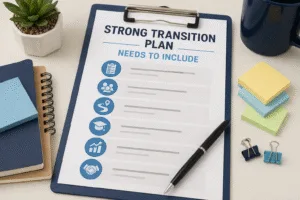
What a Strong Transition Plan Actually Needs to Include
A transition plan is not a list of hopes. It is a coordinated roadmap.
It should name specific post-secondary goals, identify agencies and services being contacted, and document concrete steps with responsible parties and timelines attached. Strong transition plans address four areas families often overlook:
- Housing: What does independent or supported living look like, and which agencies need to be contacted now rather than at graduation?
- Employment: Has the student had real work experience, not just classroom simulation? Vocational assessments can help identify work readiness and guide meaningful employment goals.
- Transportation: Can the student navigate their community independently, or does that skill still need to be built and documented?
- Self-advocacy: Does the student know their own diagnosis, their rights, and how to ask for accommodations without a parent present?
Each of these requires years of intentional development. None of them happen automatically because a document exists. The plan only works if the adults behind it treat transition as urgent and ongoing.
Teachers: your students need you to lead this conversation. Parents: you need to be asking for it by name at every annual review.
The IEP Transition Does Not Have to Be a Crisis
It becomes one when families wait, when schools do not initiate, and when everyone assumes someone else is handling the handoff.
Three things are worth holding onto.
Start earlier than you think you need to. Age 14 is not too soon to begin transition conversations. Age 16 is the legal floor, not the ideal starting point.
Treat the plan as a living document. Every annual review is a chance to update goals, add community connections, and close gaps before the clock runs out.
Build the adult-services bridge while school services still exist. Contact vocational rehabilitation, community service providers, and housing agencies while your student still has support behind them. Waiting until after graduation means joining a waitlist without a safety net.
The adult disability services system is not a continuation of what school provided. Understanding that clearly and early is how families avoid the cliff.
If you want to strengthen your ability to guide students and families through this process, explore our professional development course library. Courses like Employment Options for Students with Disabilities and Postsecondary Education and Students with Disabilities give you practical tools to move these conversations from reactive to proactive. That makes a real difference in students’ lives.