
Searching for what the MTSS diamond model actually is because your district just switched frameworks? A student in your building right now doesn’t fit the old triangle. They’re not failing enough to land in Tier 3, but they’re not thriving in Tier 1 either, and the pyramid your district has used for a decade has no real place for them.
The Triangle Was Never Built for This Many Students
For years, MTSS has been visualized as a pyramid: a wide base of Tier 1 universal support, narrowing sharply into Tier 2 targeted intervention, narrowing again into a small point of Tier 3 intensive support. The shape told a story. Most students need little. Few students need a lot. Data meetings built around that shrinking point at the top often end up sorting students rather than actually serving the ones stuck in the middle.
Achievement gaps widened. Growth slowed. The population of students who need something more than Tier 1 but less than a full special education evaluation has grown substantially, and the triangle’s narrow middle has no room for them.
What the MTSS Diamond Model Actually Changes

This newer framework widens in the middle instead of narrowing. Tier 1 still anchors the structure with high-quality core instruction for every student. But Tier 2 expands to reflect how many students genuinely need targeted, supplemental support right now, not as an exception but as the expected reality. Tier 3 remains the most intensive layer, reserved for students whose data shows they need individualized, high-frequency intervention or a formal evaluation.
The diamond also adds something the triangle never had: a strengths-based, enrichment dimension. Students who’ve already mastered grade-level content aren’t left idling in Tier 1. They move toward acceleration and extension, using the same structure that supports students who are struggling. A student can move down into intensive support or up into enrichment as their data changes, and neither direction is treated as more or less legitimate than the other.
For special education teams specifically, Tier 3 in the diamond model is where the handoff to formal evaluation happens. When Tier 3 data shows intensive support isn’t closing the gap, that’s the signal for a special education referral, not a failure of the intervention itself.
Where NASET’s MTSS Diamond Resource Fits
Building this out for your own team doesn’t require starting from scratch. The National Association of Special Education Teachers (NASET)’s MTSS Diamond Model quick reference guide breaks the framework into the pieces a team actually needs during a data meeting: what each tier looks like in practice, how fluid movement between tiers works, and what a Tier 3 evaluation conversation should cover. You can download it directly and bring it straight into your next team meeting.
For classroom-level Tier 2 strategies to pair with the diamond framework, NASET’s guide on using small group interventions to reduce challenging behaviors in the elementary classroom walks through practical, ready-to-use approaches for the exact population the diamond model is designed to serve.
Why This Shift Matters for Your Team Right Now
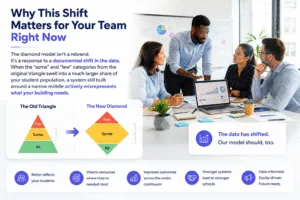
The diamond model isn’t a rebrand. It’s a response to a documented shift in the data. When the “some” and “few” categories from the original triangle swell into a much larger share of your student population, a system still built around a narrow middle actively misrepresents what your building needs.
A diamond only works when Tier 1, Tier 2, and Tier 3 stay aligned to the same instructional vision instead of operating as disconnected silos. That means your MTSS team, your general education teachers, and your special education case managers all need to be reading from the same framework, not three different interpretations of what each tier requires.
The U.S. Department of Education’s guidance on multi-tiered systems of support reinforces this same principle: tiered intervention only works when it’s implemented with fidelity and consistency across a school, not applied piecemeal by individual teachers or teams.
Building Your Own MTSS Diamond Practice

Start with your data review meetings. If they currently sort students into categories rather than generating specific instructional next steps, that’s a sign your team is still thinking in triangle terms even if you’ve adopted diamond language.
Bring the framework to your next team meeting using NASET’s cheat sheet as a shared reference point. Make sure every stakeholder, general education teachers, specialists, administrators, and families, understands both directions of movement the diamond allows. And keep Tier 3 data collection tight, since that’s the layer special education teams depend on most when a formal evaluation becomes the right next step.
The National Association of Special Education Teachers (NASET) builds resources like this one specifically to help case managers and MTSS teams close the gap between framework and daily practice. If you want deeper training on tiered intervention, data-based decision making, or the evaluation process that follows Tier 3, NASET’s membership community gives you access to a full library built for exactly this work.
Three things to carry forward. First, the diamond model reflects a real shift in how many students need supplemental support, not a passing trend. Second, fluid movement between tiers means the diamond serves both struggling and advanced students within the same structure. Third, Tier 3 remains the bridge to special education evaluation, and clean data there protects every student who eventually needs it.