
PDF File of this article – Creating a Motivating Classroom
Richard T. Boon
The University of Georgia
Vicky G. Spencer
George Mason University
Tara Jeffs
East Carolina University
Abstract
The purpose of this study was to investigate the motivational factors that lead to academic success for students with and without learning disabilities (LD) in high school inclusive content-area classrooms. Ninety-one students in regular education and 59 students with learning disabilities in grades nine through twelve were surveyed and responded to six open-ended questions to examine their attitudes and perceptions about factors that are motivating in school. Both qualitative and quantitative measures were used to analyze the data. Results indicated students with and without disabilities have common perceptions about motivational aspects in school, however, students with LD were perceived to more be extrinsically motivated by their teachers and more intrinsically motivated by their parents, while their counterparts without disabilities were found to be more intrinsic in motivational orientation. Finally, limitations of the study, implications for classroom instruction, and future research questions are discussed.
Creating a Motivating Classroom
What Really Motivates Students to Achieve in Secondary Content-Area Classrooms?
Motivation to achieve in school is often a major challenge and struggle for students with and without disabilities at the secondary level. In comparison to students without disabilities, students with mild disabilities (e.g., learning disabilities) commonly experience serious academic deficits (e.g., Bender, 2004) and speculated motivational problems, which has the potential to negatively impact their learning and academic success in schools. More specifically, students with learning disabilities often exhibit a number of complex learning and behavior characteristics. Some of these include reading, writing, and math difficulties, failure to develop and mobilize cognitive strategies, poor motor abilities, disorders of attention, a lack of motivation, low self-concept, and avoidance of tasks (Hallahan & Kauffman, 2003; Lerner, 2003).
In addition, students with LD compared to their peers without disabilities often exhibit social and emotional problems such as a lack of motivation (Borkowski, 1992), low self-esteem (Heath, 1996), poor self-concept (Bender & Wall, 1994), experience lower levels of social peer acceptance (Tur-Kaspa, 2002), and tend to display lower academic self-efficacy beliefs and negative academic attribution styles (Tabassam & Grainger, 2002). Also, students with LD are less likely to be intrinsically motivated compared to their peers without disabilities (Adelman & Chaney, 1982), attribute success and/or failure on tasks to external factors (Pintrich, Anderman, & Klovucar, 1994), and exhibit unfavorable attitudes toward academic tasks (Wilson & David, 1994), which can interact negatively with school success and may result in problem behaviors.
As a result, these behaviors are among the reasons for referral and classification of students as having learning disabilities. In addition, many speculate that when students perform poorly academically they will be less motivated to try hard in school. However, the specific nature of what appears to motivate students with and without disabilities in school is less well documented in the research literature. What are the intrinsic and extrinsic motivational factors that motivate students’ with and without disabilities to achieve in secondary content-area classrooms?
Therefore, the purpose of this study was to examine students’ attitudes and perceptions about motivating aspects in school with respect to specific content areas to determine what aspects of school are motivational for both students with and without disabilities. Through this investigation, teachers will gain greater insights into motivational factors that influence student behaviors and explore ways to creating a motivating and exciting learning environment.
Method
Subjects and Settings
Approximately 2,000 ninth through twelfth grade students attended the high school located in a suburban area in a mid-Atlantic state. A total of 150 students were included in the study and represented the range of socioeconomic status, gender, and ethnicity. Of the 150 students who participated in the survey, 91 (60.7%) were regular education students and 59 (39.3%) were identified as Learning Disabled (LD). These students met federal and state criteria for the disability classification. A description of the participants is shown in Table 1.
With the consent of administrators and teachers, who had indicated in advance that they were interested in the study as it related to student academic success, six content area teachers agreed to administer the survey in their classrooms.
Dependent Measures
A six-item open-ended survey to assess motivational factors for secondary students with and without LD was developed and piloted in three secondary inclusive classrooms to assess reliability of the instrument and to identify ambiguous or difficult to answer questions. Students were asked to review the questions for clarity and understanding. Minor revisions were made based on feedback from the preliminary group of participants.
Survey questions included the following:
1) What do you like best about school?
2) What kind of teacher do you like best?
3) What does your favorite teacher do that motivates you to work hard?
4) What motivates you to try hard at school?
5) What motivates you to complete your homework?
6) What kinds of things do your parents do to motivate you?
Procedures
Six secondary content area teachers were provided with copies of the survey and asked to administer the survey during the class period. The study was presented to the students as an effort to learn what they thought were the factors that motivate them to achieve academic success in the classroom. One hundred and fifty secondary students in inclusive content area classrooms provided written responses to the six open-ended questions.
Data Analysis
Both qualitative and quantitative techniques were used to analyze the data. Regular and special education students’ perceptions of the factors that motivate them to achieve academic success were examined using a Student Motivation Survey. The process of analytic induction (Glaser & Strauss, 1967; Robson, 1993) was used to analyze the open-ended questions. Responses were categorized by the researchers and an independent rater and grouped into similar themes to facilitate the comparison of data and to establish specific relationships. Further, the themes were revised and redefined to provide a comprehensive representation of categories. The categories were evaluated by coding the answers into SPSS and analyzing the frequencies of each question comparing regular versus special education.
Results
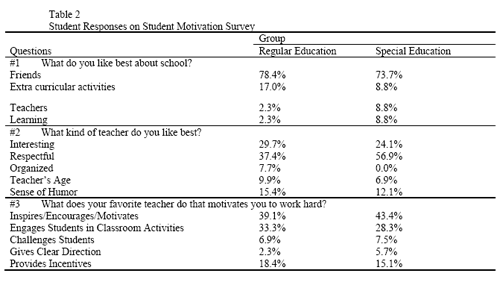
Based on the students’ written responses to the six open-ended questions, categories were identified and analyzed for each of the questions. Results are provided for each question and shown in Table 2.
Results for Question One
In response to the question that examined what the students liked best about school, four categories were identified. Sixty-nine (78.4%) of the regular education students and 42 (73.7%) of the students with LD chose “Friends” as the number one motivating factor. Fifteen (17%) of the regular education students identified “Extra curricular activities” as something they liked best about school. The lowest categories for the regular education students were “Teachers” and “Learning” with only two (2.3%) responding for each category. As for the students with LD, five students (8.8%) each identified “Extra curricular activities,” “Teachers,” and “Learning” as motivating factors.
Results for Question Two
Five categories emerged when students were asked to describe what kind of teacher they liked best. The highest category for both groups of students was “Respectful” with a response of 34 (37.4%) of the regular education students and 33 (56.9%) of the students with LD. The second highest category for both groups of students was “Interesting” with 27 (29.7%) of the regular education students and 14 (24.1%) of the students with LD responding. A teacher’s “Sense of humor” and “Teacher’s age” were third and fourth for both groups. While seven (7.7%) of the regular education students identified “Organized” as being a motivating factor of teachers they like, none of the students with LD identified this category.
Results for Question Three
The students responded to the question regarding what your favorite teacher does that motivates you to work hard with five categories. The highest category for both groups of students was “Inspires, encourages, and motivates” with 34 (39.1%) of the regular education students and 23 (43.3%) of the students with LD identifying this category. “Engages students in classroom activities” and “Provides incentives” was second and third for both groups. The lowest category for both groups was “Gives clear direction” with two (2.3%) of the regular education students responding and three (5.7%) of the students with LD responding.
Results for Question Four
In response to the question that examined what motivates students to try hard at school, twenty-seven (30.7%) of the regular education students identified “Parents” as their number one motivating factor while 24 (27.3%) of the students chose “Future goals and colleges” as second. Nineteen (35.8%) of the students with LD identified “Future goals and college” as their main motivating factor and “Parents” as their second factor with 16 (30.2%) students responding. The lowest motivating factor for the regular education students was “Teachers” with 6 (6.8%) responding and the lowest motivating factor for students with LD was “Grades” with 5 (9.4%) responding.
Results for Question Five
Five categories emerged when students were asked what motivates them to complete their homework. Twenty-seven (30.3%) of the regular education students reported that they were self-motivated while 8 (14.5%) of the students with LD identified self-motivation as a motivating factor. “Family,” “Rewards,” and “Grades,” were all important factors for the regular education students. “Family” was the strongest motivator for students with LD with 24 (43.6%) identifying this factor, but “Rewards” were also somewhat important with 13 (23.6%) reporting. The lowest motivating factor for both groups was “Don’t do homework.”
Results for Question Six
The final question on the survey examined what kinds of things their parents do to motivate these students. Thirty-eight (44.7%) of the regular education students identified “Intangible Rewards” as being the strongest motivating factor with an additional 26 (30.6%) of the students choosing “Tangible rewards” and 21 (24.7%) of them choosing “Discipline.” The students with LD were closely distributed between the three areas. Nineteen students (36.5%) identified “Tangible rewards” as the highest category with 17 (32.7%) and 16 (30.8%) following closely as the second and third categories.
Discussion
Student responses from the regular education students and the students with LD provided a great deal of diversity within each of the questions. When students were asked what they liked best about school, 111 students identified friends as being the strongest motivational factor with 42 of the students with LD responding. Although research suggests that students with disabilities often have problems with social relationships (Meadan & Halle, 2004; Tur-Kaspa & Bryan, 1994), it clearly appears that friendships are an important motivator for them; however, as Meadan and Halle (2004) would suggest, it is possible that students with LD do not gauge their friendships based on reciprocity.
Teacher characteristics also appeared to have a positive effect on students with LD. Nearly one third of the regular education students and over half of the students with LD identified “Respect” as being an important factor in the kind of teacher they liked best. These findings were consistent with Spencer and Boon (2006) who also found that showing students respect was a highly valued teacher characteristic for high school students with LD.
Interestingly, only a small number of students mentioned incentives as being a motivator, while in reality, many of the programs for students with disabilities provide incentives as part of their program. These results suggest that well-liked teachers do not rely on the use of incentives to motivate students, because they rely on encouragement and efforts that actively engage students in their work. Researchers and theorists have debated for and against the use of rewards for many years. Sprinthall, Sprinthall, and Oja (1998) stated that extrinsic motivators are necessary for learning, whereas McNinch (1997) proposed that the proper use of extrinsic rewards build a student’s intrinsic motivation when the task is presented as relevant. Further research should explore whether or not incentives are a critical part of the academic program for students with LD, and what determines the efficacy of those programs.
With regards to parental influence, regular education students stated that parents had a stronger influence on their motivation at school, while students with LD indicated that future goals/college had a greater influence. Furthermore, grades were more important for regular education students, while teachers were more important for students with LD.
In addition, a number of students, both regular education and students with LD, responded that they do not do homework. It was unclear as to whether this meant that the students do not complete homework at all or they complete it at school so they do not have any work to take home. Students with LD stated that family had a greater influence on whether or not they completed their homework, while self-motivation was a greater factor for the regular education students. Parents providing intangible rewards were an important factor for the regular education students, while tangible rewards were more important for the students with LD.
Although this information provides some intriguing insights into the motivational factors of students with LD, there are a number of limitations to be considered in interpreting the findings of the investigation. First, since the population for this study only included six inclusive secondary content-area classes in one high school, the results may not be representative of all inclusive secondary classrooms. Second, the study included a relatively small sample size of students with learning disabilities. Finally, this study was limited in the representation of various disability categories.
Implications for Classroom Instruction
Results of this investigation provide some insight into what motivates students with and without disabilities in school and at home. While students with LD may often appear to be unmotivated, it may be due to chronic academic failure (Lerner, 2003). As a result of this failure, it is imperative that educators and parents have a greater understanding of how to effectively motivate these students to strive for academic success. Sometimes, it may be as simple as just asking the students, which according to the literature, is not something that is frequently done. This kind of information provides educators and parents with greater insights into the motivational factors for students with and without disabilities in inclusive content-area classrooms. Future research should investigate supplementary motivating factors that potentially impact student achievement and motivation across age, grade level, and disability categories across the curriculum.
References
Adelman, H.S. & Chaney, L.A. (1982). Impact of motivation on task performance of children with and without psychoeducational problems. Journal of Learning Disabilities, 15, 242-244.
Bender, W. (2004). Learning disabilities: Characteristics, identification, and teaching strategies (5th ed.). New York: Allyn & Bacon.
Bender, W.N. & Wall, M.E. (1994). Social-emotional development of students with learning disabilities. Learning Disability Quarterly, 17, 323-341.
Borkowski, J.G. (1992). Metacognitive theory: A framework for teaching literacy,
writing, and math skills. Journal of Learning Disabilities, 25, 253-257.
Glaser, B.G. & Strauss, A. L. (1967). The discovery of grounded theory: Strategies for qualitative research. Hawthorne, New York: Aldine De Gruyter.
Hallahan, D. & Kauffman, J. (2003). Exceptional learners: Introduction to special
education (9th ed.). Boston: Allyn & Bacon.
Heath, N. (1996). The emotional domain: Self-concept and depression in children with learning disabilities. In T.E. Scruggs and M.A. Mastropieri (Eds.), Advances in learning and behavioral disabilities (Vol. 10, Part A, pp. 47-75). Greenwich, CT: JAI Press.
Lerner, J.W. (2003). Learning disabilities: Theories, diagnosis, and teaching strategies. (9th ed.). New York: Houghton Mifflin Company.
McNinch, G.W. (1997). Earning by learning: Changing attitudes and habits in reading. Reading Horizons, 37, 186-194.
Meadan, H. & Halle, J.W. (2004). Social perceptions of students with learning disabilities who differ in social status. Learning Disabilities Research & Practice, 19(2), 71-82.
Pintrich, E.R., Anderman, E.M., & Klobucar, C. (1994). Intraindividual differences in motivation and cognition in students with and without learning disabilities. Journal of Learning Disabilities, 27, 360-370.
Robson, C. (1993). Read world research. Malden, Massachusetts: Blackwell Publishers Ltd.
Spencer, V., & Boon, R. (2006). Influencing learning experiences: Let’s ask the Students! Intervention in School and Clinic, 41, 244-248.
Sprinthall, N.A., Sprinthall, R.C., & Oja, S.N. (1998). Educational psychology: A developmental approach (7th ed.). New York: McGraw-Hill.
Tabassam, W. & Grainger, J. (2002). Self-concept, attributional style and self-efficacy beliefs of students with learning disabilities with and without attention deficit hyperactivity disorder, Learning Disability Quarterly, 25, 141-151.
Tur-Kaspa, H. (2002). The socio-emotional adjustment of adolescents with LD in the kibbutz during high school and transition periods. Journal of Learning Disabilities, 35(1), 87-96.
Tur-Kaspa, J. & Bryan, T. (1994). Social information-processing skills of students with learning disabilities. Learning Disabilities Research & Practice, 9, 12-23.
Wilson, D.R. & David, W.J. (1994). Academic intrinsic motivation and attitudes toward school and learning of learning disabled students. Learning Disabilities Research & Practice, 9, 148-156.
Table 1
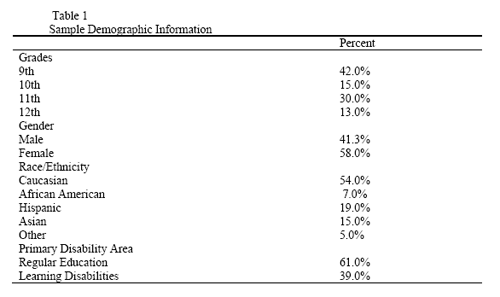
Table 2
Copyright Information
NASET would like to thank The American Academy of Special Education Professionals for the reprint rights of JAASEP Articles.
Copyright and Reprint Rights of JAASEP
JAASEP retains copyright of all original materials, however, the author(s) retains the right to use, after publication in the journal, all or part of the contribution in a modified form as part of any subsequent publication.
JAASEP is published by the American Academy of Special Education Professionals. JAASEP retains copyright of all original materials, however, the author(s) retains the right to use, after publication in the journal, all or part of the contribution in a modified form as part of any subsequent publication.
If the author(s) use the materials in a subsequent publication, whether in whole or part, JAASEP must be acknowledged as the original publisher of the article. All other requests for use or re-publication in whole or part, should be addressed to the Editor of JAASEP.
Request for reprints are to be directed to: editor@aasep.org