
Every day, students with dysorthographia sit in classrooms where their written work is marked as careless or low-effort. Their brains are working twice as hard to form a single sentence, and most of their teachers have never heard the word. That invisibility is not accidental. It is the predictable result of a system that screens for what it knows and overlooks what it does not.
You are likely supporting students right now who carry this struggle unnamed. Their IEPs address reading or behavior. Their writing scores stay low. The explanation stays missing. This article is for you, the case manager, the special education teacher, the advocate in the room.
Dysorthographia Is Not Rare. It Is Just Unnamed.
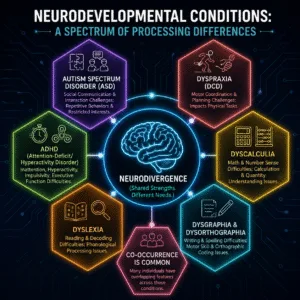
Here is the honest truth: dysorthographia is not an obscure clinical curiosity. It is a specific learning disability affecting written spelling and orthographic processing, distinct from general writing difficulty, and it is sitting in your classrooms today.
The problem is naming it. Search IEP meeting notes across most districts and the term barely surfaces. Educators who know dyslexia well, who can describe phonological processing deficits in detail, often draw a blank when dysorthographia comes up. That awareness gap means IEP teams are not screening for it, not naming it accurately, and not building supports around it even when the symptoms are unmistakably present.
A student who reverses letters, omits syllables in written work, cannot retrieve spelling patterns under time pressure, and produces written output far below their verbal ability is showing you something important. Our resource on the diagnostic symptoms of dysorthographia gives educators a concrete framework for recognizing this profile, because recognition has to come before any support can follow.
Dyslexia and Dysorthographia: Why Identifying One Is Not Enough

Learning disabilities travel together. Dyslexia, dysphasia, dyscalculia, and dysorthographia share neurological roots, and co-occurrence rates are significant. A student identified with dyslexia has a meaningfully higher likelihood of also experiencing dysorthographia. Yet school identification systems typically move one condition at a time.
If you are building your foundational knowledge of how these conditions overlap, our introduction to learning disabilities is a solid starting point that puts the full landscape in context.
Here is what partial identification looks like in practice. A third grader gets identified with dyslexia. Phonological decoding supports are put in place. Reading improves slowly. But written work remains chaotic, with misspellings that follow no pattern and sentences that collapse under the cognitive load of putting words on paper. The team attributes it to the dyslexia. The IEP does not change. The student reaches fifth grade with a reading plan and no writing plan, and the gap between their verbal intelligence and written output keeps widening.
Our resource on rhythm, prosody, and language-based learning helps illustrate how interconnected these processing systems really are. Partial identification creates partial support, and for a student with dysorthographia, partial support often feels like no support at all.
Misclassification Is Costing Students with Dysorthographia Critical Years

Here is what the data tells us. Upper elementary and middle school are where the floor drops. Written output demands increase sharply. Essays replace worksheets. Paragraphs become the baseline expectation. For a student with unidentified dysorthographia, this transition is not a developmental challenge. It is a wall, and most teams do not see it coming.
What do educators see when a student hits that wall? Avoidance. Incomplete work. Refusal to write. Minimal output on assessments. The interpretation follows the behavior: this student is resistant, unmotivated, or simply low-performing. Behavioral plans get written. Academic expectations quietly lower. The student internalizes the label. Meanwhile, the disability remains completely unaddressed.
This is your critical window. A student who was managing in second grade but is unraveling in sixth is not experiencing a behavioral shift. They may be experiencing the weight of an undiagnosed disability finally exceeding their ability to compensate. The U.S. Department of Education’s IEP Guide is clear that evaluations must address all suspected areas of disability. Suspected is the operative word. Your professional instinct counts. Use it.
How to Identify Dysorthographia: A Practical Framework
Identification is not a single test. It is a pattern of evidence you are already positioned to gather.
Start with the discrepancy. Does this student’s written work look significantly weaker than their verbal participation, their reading comprehension, or their performance on oral assessments? A consistent gap is meaningful data.
Then look at the nature of the spelling errors. Students with dysorthographia do not make random mistakes. They make predictable ones: phonetically plausible but incorrect spellings, omitted unstressed syllables, and letter-order confusion even in familiar words. These are orthographic processing failures, not carelessness.
Document writing under time pressure separately from writing with extended time. Students with dysorthographia often show dramatic performance differences when the cognitive load of speed is removed. That contrast is diagnostic information. Our resource on assessment measures used to determine learning disabilities can help you understand what to request and why during the evaluation process.
When you bring observations to evaluation conversations, be specific. Note the discrepancy between verbal and written output in your referral. Request assessment of orthographic processing, not only phonological decoding. Ask whether dysorthographia has been considered as a distinct category, not a subcategory of dyslexia. Advocate for written expression goals that address spelling retrieval specifically, not general composition quality.
You do not need to be a neuropsychologist. You need to be specific and persistent. Those two things together are more powerful than most teams realize.
What Happens After You Recognize Dyslexia
Dysorthographia will not identify itself. It waits inside low writing scores, frustrated shrugs, and the quiet resignation of students who have heard “you’re not trying” often enough to believe it.
Here is what to take from this. First, dysorthographia is distinct from dyslexia. Name it accurately and advocate for it by name. Second, when you identify one learning disability, screen actively for others in the same family. Partial identification produces partial outcomes, and your students deserve better than that. Third, middle school is not too late, but the window is closing faster than most teams recognize.
Your instinct as an educator is a legitimate part of the evaluation process. The students in your caseload who are still unnamed are counting on you to act on it. Explore the professional development courses and resources available through our NASET learning store and take the next step toward building the skills your students are counting on.