
IEP Dispute Resolution: What Case Managers Must Know
Nearly 50% of special education directors report that school-parent conflict is increasing. If you have ever sat across from a frustrated parent demanding changes you cannot legally make on the spot, that statistic is not just a number. It is your Tuesday afternoon. The tension in contentious IEP meetings carries real consequences: stalled services, legal exposure, and educators who leave the profession burned out and blindsided.
IEP dispute resolution is not a last resort reserved for broken relationships. It is a procedural framework IDEA built specifically for moments like this, and knowing it thoroughly is the difference between feeling cornered and feeling competent.
Why IEP Conflict Is Getting Worse
Conflict between schools and families is not a perception problem. According to K-12 Dive’s August 2024 reporting, nearly half of special education directors describe rising school-parent tension as a defining challenge in their work. That number reflects something structural, not personal. Policy uncertainty at the federal level, the rapid growth of parent advocacy organizations, and post-pandemic scrutiny of service delivery have all raised the stakes on both sides of the table.
Experienced case managers feel this acutely. You are not imagining the sharper emails, the attorneys appearing at annual reviews, or the parents who arrive with printed legal citations. Preparation used to mean bringing solid progress data. Now it means understanding your procedural footing before anyone sits down, because parents increasingly understand theirs.
Knowing parental rights under IDEA is no longer optional professional development. It is a necessity.
IEP Dispute Resolution Pathways Under IDEA
IDEA provides three distinct IEP dispute resolution pathways. Experienced educators often conflate them or skip straight to due process in their mental model. Each option carries different timelines, costs, and implications for the school-parent relationship. Understanding all three is essential.
State Complaint A parent or organization files a written complaint with the State Education Agency alleging a violation of IDEA. The SEA must investigate and resolve within 60 calendar days. This pathway is procedural and fact-based, and it does not require a hearing officer. Schools with documentation gaps or missed prior written notice requirements are most vulnerable here.
IEP Mediation Voluntary for both parties, mediation brings a trained, impartial mediator to facilitate agreement. It is faster than due process, preserves the relationship better, and often resolves disputes before they escalate. Many families do not know to request it. Many case managers forget they can suggest it. The IEP mediation process tends to be underutilized precisely when it would be most effective.
Due Process Hearing This is litigation-adjacent, involving formal hearings, legal representation, and binding decisions. It is not where you want to end up if mediation was a viable option. Treat due process as the last rung, not the first move.
For a structured overview of how each of these IEP dispute resolution options work in practice, the U.S. Department of Education’s IEP Guide is a reliable foundational resource.
IDEA at 50: Why the IEP Framework May Be Changing
IDEA’s 50th anniversary has triggered something beyond celebration. National education organizations, including AASA, are actively examining whether IDEA’s dispute resolution mechanisms still serve students and families well. These conversations signal that the procedural rules case managers have relied on for years are under real scrutiny.
This matters practically. If reauthorization conversations accelerate, timelines, thresholds, and procedural requirements could shift. Educators who understand the current IEP dispute resolution framework deeply will adapt faster than those who learned it loosely. The goal is not to become an attorney. The goal is fluency: knowing exactly what IDEA currently requires so you can recognize when something proposed at a meeting crosses a line.
NASET’s upcoming “IDEA at 50: Live Fireside Chat with Dr. Ed W. Martin Jr.” offers a rare opportunity to hear directly from someone who shaped the original law, especially valuable now when the conversation is shifting.
Procedural Mistakes Are Becoming More Costly
States are not waiting for federal reauthorization. New Jersey and Virginia have both moved to tighten special education compliance requirements. These are not isolated policy tweaks. They signal a broader trend: states are increasing oversight, and the margin for procedural error is shrinking.
What does a procedural misstep look like in practice? Missing a prior written notice. Failing to document a parent’s right to request mediation. Holding an IEP meeting without confirming appropriate team membership. These are the kinds of oversights that happen when case managers are handling large caseloads under time pressure. But they are exactly the issues a State Complaint will surface.
Understanding parental rights under IDEA is not about assuming parents are adversaries. It is about building the kind of procedural discipline that protects everyone: the student, the parent, and you. Case managers who know the IDEA dispute resolution options are harder to blindside, easier to trust, and far better positioned to de-escalate a contentious IEP meeting before it leaves the room.
What to Do During an IEP Meeting When Conflict Erupts
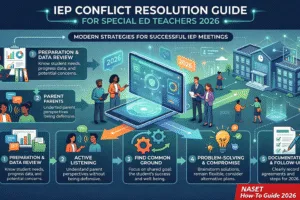
No procedural framework eliminates the moment when a parent’s voice rises and the meeting goes sideways. Here is what that moment actually calls for.
Name the disagreement clearly. Do not minimize it. Saying “I hear that we see this differently” is more grounding than deflection.
Slow the meeting down. You have the right to pause, regroup, and reconvene. A decision made under pressure is rarely a good one.
Offer the formal pathways explicitly. Many parents do not know they can request mediation or file a State Complaint. Telling them calmly and professionally builds trust and shifts the dynamic.
Document everything before you leave the building. Memory fades. Notes do not.
The goal in that room is not to win. It is to keep the student’s needs centered and the IEP process intact. For additional tools to support your documentation and preparation, explore NASET’s IEP forms, checklists, and procedures for special education teachers.
Build Confidence Before the Next Hard Meeting
The pressure educators face in contentious IEP meetings is real, documented, and escalating. The framework for navigating IEP dispute resolution already exists, and knowing it thoroughly is what keeps you steady when the meeting gets hard.
Three things to carry forward: understand all three IDEA dispute resolution pathways before you need them, recognize that procedural compliance protects everyone in the room, and treat mediation as the underused tool it is.
If you want to build genuine confidence in this space, NASET’s BCASE certification trains educators in dispute resolution options, parental rights, and the advocacy skills needed to represent every student’s best interests with credibility. It is the kind of preparation that shows up when the IEP meeting gets hard.