What is a Multitiered Service Delivery Model?
Responsiveness to intervention (RTI) is a multitiered service-delivery model. An RTI approach incorporates a multitiered model of educational service delivery in which each tier represents increasingly intense services that are associated with increasing levels of learner needs. The various tier interventions are designed to provide a set of curricular/instructional processes aimed at improving student response to instruction and student outcomes.
Much discussion continues surrounding the issues of how many tiers constitute an adequate intervention (O’Connor, Tilly, Vaughn & Marston, 2003). Most frequently, RTI is viewed as a three-tiered model, similar to those used for other service delivery practices, such as positive behavioral support. The three-tiered model is the structure we will discuss here. Figure 1 depicts a three-tiered model as conceived in an RTI framework.
Like other models, RTI is meant to be applied on a school-wide basis, in which the majority of students receive instruction in Tier One (the general classroom), students who are at risk for reading and other learning disabilities are identified (such as through school-wide screening) for more intense support in Tier Two, and students who fail to respond to the interventions provided in Tier Two may then be considered for specialized instruction in Tier Three.
Continuum of Intervention Support for At-Risk Students
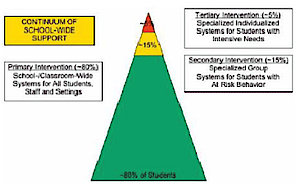
The application of RTI is typically understood within the context of a multitiered model or framework that delineates a continuum of programs and services for students with academic difficulties. Although no universally accepted model or approach currently exists, the many possible variations can be conceptualized as elaborations on or modifications of the following three-tiered model:
1.) Tier 1: High quality instructional and behavioral supports are provided for all students in general education.
- School personnel conduct universal screening of literacy skills, academics, and behavior.
- Teachers implement a variety of research-supported teaching strategies and approaches.
- Ongoing, curriculum-based assessment and continuous progress monitoring are used to guide high-quality instruction.
- Students receive differentiated instruction based on data from ongoing assessments.
2.) Tier 2: Students whose performance and rate of progress lag behind those of peers in their classroom, school, or district receive more specialized prevention or remediation within general education.
- Curriculum-based measures are used to identify which students continue to need assistance, and with what specific kinds of skills.
- Collaborative problem solving is used to design and implement instructional support for students that may consist of a standard protocol or more individualized strategies and interventions.
- Identified students receive more intensive scientific, research-based instruction targeted to their individual needs.
- Student progress is monitored frequently to determine intervention effectiveness and needed modifications.
- Systematic assessment is conducted to determine the fidelity or integrity with which instruction and interventions are implemented.
- Parents are informed and included in the planning and monitoring of their child’s progress in Tier 2 specialized interventions.
- General education teachers receive support (e.g., training, consultation, direct services for students), as needed, from other qualified educators in implementing interventions and monitoring student progress.
3.) Tier 3: Comprehensive evaluation is conducted by a multidisciplinary team to determine eligibility for special education and related services.
- Parents are informed of their due process rights and consent is obtained for the comprehensive evaluation needed to determine whether the student has a disability and is eligible for special education and related services.
- Evaluation uses multiple sources of assessment data, which may include data from standardized and norm-referenced measures; observations made by parents, students, and teachers; and data collected in Tiers 1 and 2.
- Intensive, systematic, specialized instruction is provided and additional RTI data are collected, as needed, in accordance with special education timelines and other mandates.
- Procedural safeguards concerning evaluations and eligibility determinations apply, as required by IDEA 2004 mandates.
D. Fuchs et al. (2003) used the term standard protocol to refer to an approach in which students with similar difficulties (e.g., problems with reading fluency) are given a research-based intervention that has been standardized and shown to be effective for students with similar difficulties and uses a standard protocol to ensure implementation integrity. The term is used in this sense in this report.
Variations on this basic framework may be illustrated by options often found within Tier 2. For example, Tier 2 might consist of two hierarchical steps, or sub-tiers (e.g., a teacher first collaborates with a single colleague, then, if needed, problem-solves with a multidisciplinary team, creating in effect a four-tiered model). Alternatively, more than one type of intervention might be provided within Tier 2 (e.g., both a standard protocol and individualized planning, based on the student’s apparent needs).
RTI is a critical component of a multitiered service delivery system. The goal of such a system is to ensure that quality instruction, good teaching practices, differentiated instruction, and remedial opportunities are available in general education, and that special education is provided for students with disabilities who require more specialized services than what can be provided in general education. The continuous monitoring of the adequacy of student response to instruction is particularly relevant to an RTI approach as a means of determining whether a student should move from one tier to the next by documenting that existing instruction and support is not sufficient. For example, in moving from Tier 2 to Tier 3, insufficient responsiveness to high quality, scientific, research-based intervention may be cause to suspect that a student has a disability and should be referred for a special education evaluation. In addition, however, the right of a parent, state education agency, or a local education agency to initiate a request for an evaluation at any time is maintained in IDEA 2004.
Tier I Intervention
One concern about current approaches to SLD identification is the number of students who may actually be “instructional casualties,” those students who have not received scientific, research-based instruction in reading or other academic skill areas. Tier One instruction is designed to provide for the majority of students’ needs and consists of three elements:
- Research-based core instructional programs provided by the general education teacher
- Progress monitoring of students such as through curriculum-based measurement (CBM)
- Analysis of the progress monitoring results to determine which students are at risk and require more intense instructional support.
This first level of instruction is designed to serve all students with well-supported instructional programs. General education teachers would be required to adopt evidence-based instructional programs in reading, math, and writing and to be responsible for the continual monitoring of their students’ progress. Results of the progress monitoring would be reviewed periodically to determine which students were failing to make adequate progress and would qualify for Tier Two intervention.
What is Tier I-Core Instruction?
In the RTI framework, all students in Tier I receive high quality scientific, research based instruction from general education teachers in the core curriculum. The core curriculum provides the foundation for instruction upon which all strategic and intensive interventions are formulated. While Tier I instruction occurs in the general education setting, it is not necessarily grade level instruction. Instruction at Tier I includes all developmental domains such as behavioral and social development along with instruction in academic content areas.. At this phase, general education teachers match students’ prerequisite skills with course content to create an appropriate instructional match and use instructional strategies with fidelity that are evidence-based.
What Percentage of the Student Body Must Tier I Serve?
Tier I instruction must be both differentiated and culturally responsive to serve approximately 80-90% of the student body and is effective for the vast majority of students.
What are the Core Features of a Tier 1 Intervention?
Tier 1 includes the following features:
Size of instructional group.
Tier 1 instruction is provided to the whole class.
Mastery requirements of content.
Cut points identified on screening measures and continued growth as demonstrated by routine progress monitoring are indicators of content mastery.
Frequency and focus of screening.
In general, screening assessments occur at least three times per year, are school wide, use a broad index, and are used to identify students who are at risk and to inform school or class-wide instruction and curriculum decisions.
Frequency and focus of progress monitoring.
Recommendations on progress monitoring vary. In general, progress monitoring occurs at least once every three weeks, often as frequently as weekly, twice weekly, or even daily. Progress monitoring takes place in all tiers. At-risk students in Tier 1 need to be monitored at a more frequent rate than the three times per year rate provided by screening. Some researchers (Fuchs, 1989) suggest the monitoring monitoring of student progress at Tier 1 either weekly or twice a week. It is likely that students who receive Tier 2, Tier 3 or special education interventions will require progress to be monitored at least weekly and often more frequently. Progress monitoring assessments are focused on a class, small group, or individual student and target a specific academic skill. Results of progress monitoring provide data that can be used to make decisions about regrouping students or about continuing, revising, or changing an intervention.
Duration of the intervention.
Students remain in Tier 1 throughout the school year unless found eligible for special education and specially designed instruction that cannot be provided in the general classroom.
Frequency with which the intervention is delivered.
Instruction in Tier 1 intervention occurs according to school schedules and curriculum guidelines.
Instructor qualifications.
Tier 1 instruction is provided by general educators who are “highly qualified” as defined by NCLB 2001 legislation. Tier 1 intervention is characterized by high-quality, scientifically based instruction that occurs in the general education classroom and is implemented by the general education teacher. The use of scientifically based programs and practices ensures that student difficulties cannot be attributed to inappropriate or ineffective, poor-quality classroom instruction. Moreover, NCLB 2001 mandates the use of “scientifically-validated instruction” among practitioners.
Several resources are available to assist consumers in evaluating whether an educational intervention is supported by scientifically based research. For example, the Coalition for Evidence-Based Policy (2003) advances the following three-step process in its guide, “Identifying and Implementing Educational Practices Supported by Rigorous Evidence: A User Friendly Guide,” to evaluate whether an educational intervention is supported by rigorous evidence:
1.) Is the intervention backed by strong evidence (quality and quantity needed) of effectiveness?
2.) If this intervention is not backed by “strong” evidence, is it backed by “possible” evidence of effectiveness?
3.) If the answers to both questions above are “no,” one may conclude that meaningful evidence does not support the intervention.
How Does Tier 1 Fit Within an RTI Model?
In RTI systems, Tier 1 instruction is the base level of educational service delivery aimed at meeting the needs of most students in the school setting. Accordingly, most students will achieve academic success when provided Tier 1 instruction as described in this section. Tier 1 reduces the incidence of “instructional casualties” by ensuring that students are provided high-quality instruction and monitoring.
Tier 1 is particularly important as this intervention level represents the first “gate” in a system designed to better accommodate the diverse learning needs of all students. Tier 1 provides the foundation for instruction upon which all supplementary interventions (e.g., Tier 2 and beyond, special education) are formulated in a system of responsiveness to intervention. An important benefit of Tier 1 instruction is that the high-quality instruction and monitoring highlights students who need supplemental support (e.g., small-group or individualized instruction that is more intense or frequent).
What is Universal Screening and/or Benchmarking?
An important first step in identifying at-risk students is the use of universal screening and/or benchmarking of students in all core academic areas and behavior. Students who are at-risk are not suspected as having a disability absent other data or indicators. At Tier I, universal screening for all students is conducted at least three times during a school year: fall, winter and spring. Scores earned at different times during the year are used to determine whether a student’s performance and progress is increasing, decreasing, or staying the same. Universal screening is typically done through brief assessments such as curriculum-based measures (CBMs). Significant numbers of students meeting proficiency levels (e.g., 80% or greater) based on the results of universal screening tools is an indicator that the instruction in the core curriculum is effective. When there is evidence that instruction in the core curriculum is not effective, schools must examine whether it is occurring school-wide or whether it is a class specific problem. If, for example, a school has a high percentage of students with a particular risk factor for low achievement (e.g., low-income) this does not automatically mean it is acceptable to refer a higher proportion of students in that school for special education services. Instead, consideration should be given to redesigning the core program so that it meets the needs of the school’s core student population. When the core curriculum is effective, interventions within the core will need to be made for at-risk students in accordance with their individual needs based on universal screening/benchmarking data, followed by progress monitoring.
While a variety of universal screening tools are available, schools are encouraged to choose tools that are easy to administer and analyze. Schools may utilize multiple convergent sources for screening students, including: district-wide assessments; existing data; classroom data; CBMs; and other measurements. To ensure valid and reliable results, directions for administering screening tools and scoring the results should be explicitly followed. Teachers and staff administering and scoring screening tools should receive ongoing professional development to ensure fidelity of administration and reliability of scores. Schools should identify a standard procedure with specified criteria or benchmarks for identifying students “at-risk” (e.g., create a table of cut points or patterns of performance, etc.). However, a cut score alone does not warrant movement to Tier II absent Tier I interventions that have been tried and proven to be unsuccessful.
How is Progress Monitoring Done in Tier I?
Progress monitoring documents student growth over time to determine whether the student is progressing as expected in the core curriculum. In Tier I, progress monitoring is recommended in addition to general screening/benchmarking measures for those at-risk students that were not performing in accordance with standards.
Analysis of the screening data and progress monitoring will expose false positives, (students that appear to have skill deficits but do not) and false negatives (students that do not appear to have skill deficits, but do). Unidentified, false positives result in an over identification of students in need of strategic or intensive interventions that can be costly and time consuming. False negatives, on the other hand, can result in an under identification of students in need of Tier II or Tier III interventions.
Schools should implement screening instruments with fidelity and emphasize high sensitivity and specificity. When choosing screening instruments, greater emphasis should be placed on sensitivity to ensure identification of at risk students. The trade off can be increased false positives which will later be identified through progress monitoring.
CBMs are primarily used as a method for progress monitoring and are characterized as brief, easy to administer and score, and produce measures that are good predictors of a student’s academic ability. CBMs are used for both screening/benchmarking and progress monitoring.
Other measures of student performance such as classroom observations, state-wide and district-wide assessments, and other standardized testing may be considered when measuring the effectiveness of the interventions provided. The data collected during progress monitoring at Tier I to at risk students helps teams make informed decisions at the classroom level. These data provide a picture of the student’s performance and rate of growth (e.g., progress) to inform instructional and curricular changes so that every student reaches proficiency on targeted skills.
What if Students Do NOT reach a Proficiency Level at Tier I?
Students who do not reach a proficiency level at Tier I will need more strategic interventions. Lack of responsiveness is defined as the rate of improvement, or a progress slope, that is not sufficient for the student to become proficient with state standards without more interventions. Five weeks or more after progress monitoring has been initiated for at risk students is suggested as a sufficient period to review lack of responsiveness at Tier I. The decision to advance to Tier II is based upon an analysis of the progress monitoring data and a determination of a lack of responsiveness at Tier I.
How Will Tier 1 Interventions Affect Staff and School Structures?
Tier 1 will require significant changes to many staff roles and responsibilities and to school structures.
RTI models are intended to provide needed interventions to students in a timely manner. These models work in the context of general education and as such help ensure that students do make adequate yearly progress toward the state’s learner outcomes. For many schools, this shift differs from special education as the primary service model for students with learning or performance problems. In RTI models, general education staffs have responsibility for examining student progress and achievement through a system designed to support student success and “catch” all students who experience trouble. Such a system requires an integrated approach to service delivery that includes “leadership, collaborative planning, and implementation by professionals across the education system” (NASDSE, 2005, p. 3). This approach represents a significant change in typical roles within the school structures. In Tier 1, general educators take a more active role in the screening, identification, and intervention processes of students judged as at risk (as evidenced by predictive screening measure results) or not meeting adequate progress (as evidenced by progress monitoring measure results).
In the RTI framework, student progress/achievement is monitored very closely—revealing a subset of students who are at risk for school failure. Some of these at-risk students will require specialized interventions within general education while others may have a disability that will be diagnosed and treated with special education. Regardless, close collaboration between general and special education will promote a more seamless system of service provision that will strengthen both the delivery of high-quality interventions for all students and the integrity of the disability identification process (Learning Disabilities Roundtable, 2002).
Tier II Interventions
What is an Intervention?
Intervention means extra help or extra instruction that is targeted specifically to skills that a student has not acquired. During intervention time, the teacher selects approaches that reach students while providing numerous opportunities for practice, feedback and error correction. Options teachers can use to adjust the intervention include increasing time allowed for intervention, decreasing group size, changing materials or strategies, or moving students to a different group.
What is a Tier 2 Intervention?
Tier Two intervention is for those students for whom Tier One instruction is insufficient and who are falling behind on benchmark skills and require additional instruction to achieve grade-level expectations. Although many variations of Tier Two interventions are described in the research, in general, Tier Two is small-group supplemental instruction (ratio of up to one teacher to five students, 1:5) provided by a specialist, tutor, or special education teacher to students who fail to make adequate progress in the general classroom. Tier Two includes programs, strategies, and procedures designed and employed to supplement, enhance, and support Tier One instruction to all students.
At Tier II, strategic interventions are provided to students who are not achieving the desired standards through the core curriculum alone. Strategic interventions supplement the instruction in the core curriculum provided in Tier I and should be targeted at identified student needs and stated in an intervention plan. Decisions about selecting the appropriate strategic interventions should be made when a student enters Tier II and then reviewed through progress monitoring at appropriate intervals after interventions are implemented.
When Does Tier 2 Intervention Start?
Tier Two instruction starts as soon as possible after students have been identified as falling behind grade expectations through benchmark testing. In this way, it differs from current approaches to SLD identification in which a student must undergo a lengthy referral and evaluation system before receiving supplemental instruction. The evidence on Tier Two interventions supports the use of a standard protocol approach, in which the supplemental instruction also is centered on evidence-based practices for students at risk. The progress of students in Tier Two also is monitored to determine whether they are responding to the intervention.
What Percentage of Students Need Tier II Interventions?
Tier II typically consists of 5-10% of the student body.
Are Strategic Interventions in Tier II Short or Long-Term?
Strategic interventions are intended to be short-term in duration (e.g., 9-12 week blocks) and are in place for immediate implementation. Interventions are generally provided in small groups of three to six students and may occur in the main classroom or in other settings. It is recommended that interventions at Tier II consist of three to four sessions per week at 30-60 minutes per session. Instruction must be provided by trained staff and supervised by individuals with expertise in the intervention chosen by the decision making team. Students may benefit from more than one Tier II intervention cycle.
Schools set up and deliver strategic interventions that are designed to address routine problems exhibited by students. When selecting materials for strategic interventions, districts and schools are encouraged to identify 2-3 programs, or fewer, per academic area and to utilize on a district-wide or school-wide basis for behavior. Districts or schools can identify additional programs, though limiting programs to two or three prevents redundancy and a lack of coordination across or among programs. It also reduces the amount of professional development that would be required to implement strategic interventions.
What are the Core Features of a Tier 2 (and beyond) Intervention?
Tier 2 and beyond consists of general education instruction plus specialized intervention that has the following features:
Size of instructional group.
Tier 2 and beyond instruction is provided in small groups (two to four students).
Mastery requirements of content.
Cut scores identified on screening measures and continued growth as demonstrated by routine progress moni¬toring are indicators of content mastery.
Frequency of progress monitoring.
Although recommendations vary, weekly to three times per week monitoring of progress is typical.
Duration of the intervention.
Tier 2 and beyond interventions last for nine to 12 weeks and can be repeated as needed.
Frequency with which the intervention is delivered.
Tier 2 and beyond provides for three to four intervention sessions per week, each lasting 30 to 60 minutes.
Instructor qualifications.
Instruction is conducted by trained and supervised personnel (not the classroom teacher).
Placement in and completion of Tier 2 and beyond interventions can result in one of three possible outcomes (Vaughn, 2003):
1.) Successful progress is made in the area of deficit and the student exits Tier 2 and beyond instruction to return to only Tier 1 instruction.
2.) Although progress is being made, the student has not progressed enough to warrant leaving and thus remains in Tier 2 and beyond for continuation of the intervention.
3.) The rate and amount of progress or the level of support required for the student warrants referral for special education eligibility determination.
How Long Should Tier 2 Interventions Be?
Although no clear consensus exists on the duration of Tier Two interventions, in general, the research supports 8 to 12 weeks for each round of intervention. At the end of this period, a decision should be made about the student’s instructional needs. The options to be considered include the following:
- Return to the general education classroom if the student has made sufficient progress.
- Receive another round of Tier Two intervention if the student is achieving progress but still remains behind his/her grade-level expectations (e.g., perhaps repeat the intervention or change to another scientific, research-based intervention depending on progress monitoring results).
- Consider for more intensive intervention in Tier Three.
What is a Problem-Solving Approach (Individually Designed Instructional Package)?
Most schools currently have an existing form of a problem-solving team, such as a student instructional team (SIT), student study teams (SST), or building assistance team (BAT). The purpose of these teams is to develop an accommodation or modification plan for the instructional program in the general education classroom to support the targeted student, while simultaneously providing a positive effect on the instructional program for all students. Under an RTI service-delivery system, these teams would adopt a problem-solving approach that is based on data and a continuing system of evaluation.
Problems need to be objectively defined, observed, and measured directly in the general education classroom. The data collected are then analyzed, using information to develop hypotheses about the cause of the problem and the appropriate selection of evidence-based strategies to remedy them. As the interventions are implemented, the student’s progress is monitored at regular points in time. The team continues to meet to discuss the outcome data and determine whether the intervention is having its desired effect, whether the specific intervention needs to be revised, or whether the student should be considered for further evaluation.
Some researchers say that the research on the problem-solving approach suggests it will be used most effectively when developed and implemented according to following attributes:
- A scientific approach to problem solving
- Interventions designed for an individual student
- A system for continual monitoring/evaluation of intervention
- Collaborative relationships with general education and special education to develop, implement, and monitor the intervention
- Collection of information from a variety of sources, including teachers, parents, and others who best know the child
- Use of curriculum-based measurement (CBM) to assist in problem identification and for continuing progress monitoring and evaluation of the effectiveness of the intervention
- Interventions embedded in the daily classroom routine so the classroom teacher takes responsibility for implementation
(adapted from Kovaleski, 2003)
At this point, the evidence supporting these attributes is insufficient. Whereas problem solving has been shown to be a scientifically validated approach to help children with behavioral problems, the evidence is insufficient to show effectiveness for children with severe reading and math problems.
What is a Standard-Protocol Approach?
Standardized protocols are interventions that researchers have validated as effective, meaning that the experimental applications were completed with the proper experimental and control groups to demonstrate that the interventions work. School staff is expected to implement specific research-based interventions to address the student’s difficulties. These interventions are not accommodations to existing curriculum; rather, they are instructional programs targeted to remediate a specific skill. Research for standard protocol interventions should specify the conditions under which the intervention has proven successful, including the number of minutes per day, the number of days per week, and the number of weeks (typically eight to 12) required for instruction with the intervention. Information about each research-based intervention also should describe the specific skills addressed, where the instruction should be provided, who should provide the instruction, and the materials used for instruction and assessing progress (adapted from Fuchs et al., 2003).
Many standardized protocols for reading have been developed. Some are listed in the resources section at the end of this chapter. Some of the key characteristics in a program of Tier 2 and beyond intervention include the following:
Focus
The focus is on students identified with marked reading difficulties and whose response to Tier 1 efforts places them at risk for reading problems. Instruction involves specialized, scientifically based reading programs that emphasize the critical elements of beginning reading.
Grouping
Instruction is provided in homogeneous small groups (teacher-to-student ratios of one-to-three, one-to-four, or one-to-five).
Time
A recommended minimum of 30 minutes of instruction per day in a small group in addition to core reading instruction, generally provided over a period of eight to 12 weeks after which a determination is made about whether the student needs to continue in the program, move to more intense levels of intervention, or leave the program to receive Tier 1 instruction only.
Assessment
Students in Tier 2 and beyond should have their progress monitored on a weekly basis on the targeted skill to ensure adequate progress and learning. Progress monitoring on Tier 1 skills should continue to be monitored to determine whether the intervention is resulting in improvements in reading.
Interventionist
Personnel are determined by the school, but possible options are the classroom teacher, a specialized reading teacher, or an external interventionist, such as a tutor.
Setting
Instruction is provided in an appropriate setting—either within or outside of the classroom—designated by the school.
How is Progress Monitoring Done in Tier II?
At Tier II, progress monitoring involves reviewing existing data of the student’s performance and progress using CBM tools. Progress monitoring is done more frequently at Tier II than Tier I, usually occurring at least two times per month, or more frequently as determined by the decision making team. Data gathered through Tier II progress monitoring informs teams of modifications needed to student intervention plans. For example, if progress monitoring data reflects student performance below the goal line over four consecutive periods of data collection, the amount and frequency of the intervention should be increased, or new strategic interventions should be added.
What if Students are Successful at Tier II? What if They are Unsuccessful?
Students who are successful at Tier II may be reintegrated into Tier I. However, for a small percentage of students, Tier II interventions will not be enough. If a student is not meeting proficiency after it is determined that Tier II strategic interventions have been implemented with fidelity, the student will require intensive interventions at Tier III.
How Does Tier 2 (and Beyond) Fit Within an RTI Model?
We distinguish between Tier 2 and beyond interventions that might be part of an SLD determination process and a Tier 2 and beyond model used in providing early intervention for students who are at risk for failure.
In the former case, the Tier 2 and beyond interventions have an assessment role and address the assessment question of how well a student responds to a specific research-based intervention. In this role, if a student is performing at a lower level of achievement or is learning at a significantly slower rate than his or her peer group, RTI is used to determine whether inadequate instruction would account for this discrepancy.
In the latter case, Tier 2 and beyond is considered to be an intervention intended to remediate the student’s deficits and promote participation in Tier 1 with general education students. Other researchers have offered a similar view of this latter purpose. Many people think of Tier 2 and beyond interventions as prereferral interventions, or “prereferral writ large” (Kavale, Holdnack, Mostert, & Schmied, 2003), that provide support to struggling students and prevent referral to special education.
Two approaches to structuring Tier 2 and beyond interventions have been described in the research literature: (1) problem-solving and (2) standard treatment or intervention protocol (Fuchs, Mock, Morgan, & Young, 2003). Although the two vary in their focus and implementation, the goal of each is to provide supplemental instruction to students for whom Tier 1 instruction is insufficient. Some schools may incorporate a combination of these two approaches. In some implementations, the two approaches occur sequentially with the standard intervention protocol occurring first.
Will Tier 2 (and Beyond) Interventions Affect Staff Roles, Responsibilities and School Structures?
Tier 2 and beyond interventions will require significant changes to many staff roles and responsibilities and to school structures. Specifically, schools will need to do the following:
- Develop or adopt an aligned system of progress monitoring and screening measures to identify the population of students as at risk or not making adequate progress in the general education curriculum and therefore eligible for Tier 2 and beyond interventions.
- Identify scientifically based interventions across the academic domains that can be implemented as intended.
- Adopt a standardized protocol (i.e., reading intervention curriculum) that is scientifically based.
- Adopt detailed procedures for consistent implementation of a standard treatment protocol or problem-solving framework for tiered intervention (Fuchs et al., 2003).
- Provide teacher and staff development to ensure sufficient staff to provide small-group instruction.
- Adopt a system for continued progress monitoring and review of results along with set criteria for exit, continuation in Tier 2 and beyond, or consideration for movement to special education levels.
Tier III Interventions
What are Tier III Interventions?
Intensive interventions at Tier III are designed to accelerate a student’s rate of learning by increasing the frequency and duration of individualized interventions based on targeted assessments that analyze the lack of responsiveness to the interventions provided at Tier I and Tier II. Intensive interventions at Tier III may either support and enhance instruction provided at Tier I and supported by Tier II, or be substituted for a portion of the Tier I and Tier II interventions if those interventions have been tried with increased frequency and duration and proven ineffective. Students at Tier III are those students who are performing significantly below standards and who have not adequately responded to high quality interventions provided at Tier I and Tier II.
What Percentage of Students Need Tier III Interventions?
Tier III generally serves fewer than 5% of the student body.
Are Tier III Interventions Short-Term or Long-Term?
Tier Three intervention is intensive, strategic, supplemental and often considerably longer in duration than the 10 to 12 weeks of supplemental instruction provided in Tier Two. In most schools, Tier Three might be synonymous with special education. Tier Three is for students who fail to make sufficient progress after receiving Tier Two interventions. In some RTI models, students who fail to make adequate progress after two rounds of Tier Two may be referred for Tier Three interventions. Students who receive only one round of Tier Two intervention but whose progress is severely limited also may be referred to Tier Three.
Who Delivers Tier III Interventions?
Instructional support in Tier Three will most likely be delivered by the best qualified teacher or specialist to provide sustained, intensive support in the specified area of need. Instruction is individualized or delivered in small groups, with a ratio of no more than one teacher to three students, 1:3. Tier Three differs from Tier Two in that it is more intensive instructional support, tailored to the individual student and may continue for much longer periods, depending on student need. In Tier Three, the student’s needs are more significant, which necessitates a more intense intervention.
Is Progress Monitoring Still a Part of Tier III?
Progress monitoring is a continual part of Tier Three and is used to carefully observe student response to the intervention, report his/her progress to parents, and determine future instructional placements. As a general guideline, a student is ready to exit the intervention when he/she has reached benchmark on the targeted skills. Students who meet targets of Tier Three and are exited to Tier One, but who fail to thrive without that support, also may reenter Tier Two or, if needed, Tier Three until they are able to maintain progress in Tier One.
How are Tier III Interventions Delivered?
Prior to selecting intensive interventions, targeted assessments are typically conducted when a student enters Tier III. These assessments use direct measures in addition to analysis of RTI data to provide more in-depth information about a student’s instructional needs and are used to identify the student’s skill deficits. Targeted assessments may be administered by reading specialists, Title I/LAP teachers, school psychologists, special education teachers, specially trained general education teachers, or other specialists. Targeted assessments include the use of interviews, observations, error analysis techniques, CBMs, CBM mastery measures, which are used to target a very narrow skill, other standardized assessments, and/or functional behavioral assessments.
What if Students are Successful at Tier III? What if They are Unsuccessful?
Students who are successful at Tier III may be returned to previous tiers and/or the core curriculum. Students who are not successful after multiple Tier III intensive interventions must be considered for a referral for special education evaluation and/or other long-term planning (e.g., 504 plan, additional Tier III cycle, etc
Download this Issue
To Download a PDF file version of this Issue of the NASET RTI Roundtable – CLICK HERE