
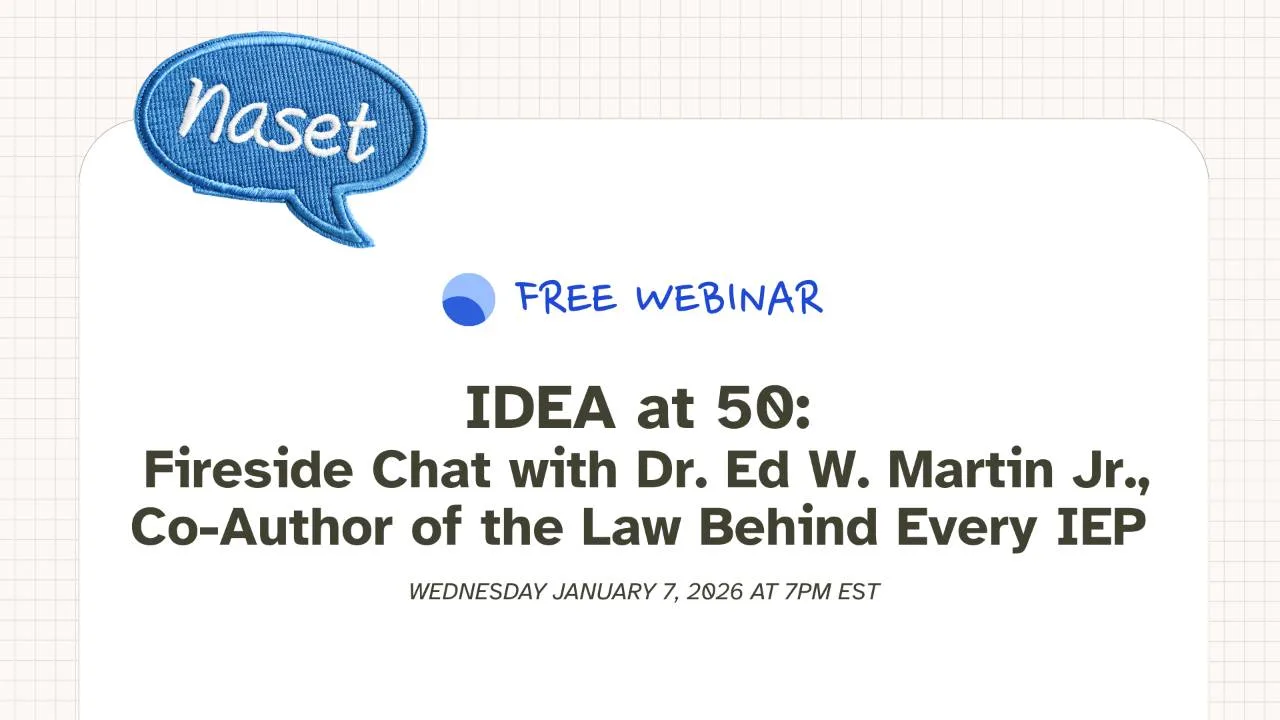
We kicked off our 2026 with a living legend: Dr. Edwin W. Martin Jr., the original architect of the federal legislation that became IDEA.
Dr. Martin is a giant in the field of special education policy. His credentials map the history of the disability rights movement:
- Bipartisan Leader: He served under Presidents Johnson, Nixon, Ford, and Carter, proving that the rights of children transcend politics.
- The Co-Author: As a key congressional staffer and Director of the Bureau of Education for the Handicapped, he was instrumental in drafting P.L. 94-142.
- The First Assistant Secretary: He was appointed by President Carter as the first-ever U.S. Assistant Secretary of Education for Special Education and Rehabilitative Services.
Key Takeaways
IDEA’s “origin story” started earlier than most people realize (mid-1960s) and grew out of grants first.
Dr. Martin described the early push as building federal support for training and state grants (Title 6 of ESEA) before the full national entitlement framework arrived in 1975.
Parents + educators moving policymakers emotionally (not just intellectually) was the real accelerant.
He was blunt that research-only arguments did not move Congress, but stories, visibility, and “humanizing the experience” did.
FAPE was intentionally plain language, then operationalized through the IEP process.
“Free” (no private-school-only pathway), “public” (a public responsibility), and “appropriate” (defined locally through IEP goals, strategies, and measurement). He emphasized the IEP was designed to be simple at its core: set goals, plan strategies, measure progress.
Least Restrictive Environment is not automatically full inclusion.
He repeatedly returned to “where appropriate” and the “continuum of placements,” including the idea that some specialized settings can be affirming and effective when chosen intentionally and reviewed with student voice.
One of his biggest disappointments is the lack of a stronger, scaled research engine behind special education practice.
He framed today’s persistent struggle as less about the law being “broken” and more about the field still needing better evidence about what works, how to replicate it, and how to measure outcomes fairly.
Key Questions Covered In The Webinar
- What problem was IDEA originally designed to solve, and what made it politically possible?
- What did “Free Appropriate Public Education” actually mean in practice, not theory?
- Does Least Restrictive Environment automatically mean inclusion?
- Has compliance culture overtaken educational outcomes?
- What are the greatest positive changes for students over 50 years?
- What are the biggest gaps between IDEA’s intent and today’s reality?
- Why has the federal government never met its funding “promise”?
- Was it a mistake to rely so heavily on parents for enforcement?
- Is IDEA enforcement realistically at risk right now?
- If you could update IDEA today, what would you change?