
In This Issue:
How To Strategies for Improving Handwriting
&
How To Determine Extended School Year Services
How To Strategies for Improving Handwriting
From: Julia Van Alst at Make, Take & Teach
There is so much you can learn about a student’s phonics skills just from looking at writing samples. One of the big “ah-ha” moments from my Phonics First training (Orton-Gillingham based program) was when the trainer said that a student has not fully mastered a phonics rule until you see him/her use it in writing. Of course, that makes sense. Sometimes you just need someone to point out the obvious. Since that time, I’ve made it a point to really take some time to analyze writing samples. One of the problems I’m having with some students is actually trying to read what they are writing. This issue has led to numerous conversations with our Occupational Therapists regarding handwriting. Admittedly, it the past, when I came across illegible writing, I was quick to call in the OT. But lately, in the spirit of Response to Intervention (RtI), I’ve been working with teachers in providing strategies first. Here are some strategies for commonly occurring handwriting issues:
Letter Size Differentiation
The writing of students whose lowercase letters are as large as the uppercase letters or their “descending” letters don’t drop below the line is difficult to read. Our OT’s refer to this as “letter-size differentiation”. Students need to be taught that tall letters are “tall” and reach the top line (e.g. b, d, f, h, k), small letters are “small” and are printed in the middle of the line (e.g. a, c, e) and descending letters drop below the bottom line (e.g. p, g). To help cue students into the correct formation of the letters, having them practice writing letters on highlighted paper and/or using the highlighted paper for writing assignments can be beneficial.
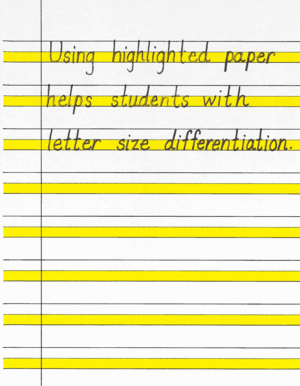
Hi Write Hi-Write Wide-Ruled Notebook Paper
Hi-Write Beginner 1 Paper – Pack of 100
Hi Write Intermediate Paper – Pack of 100 Pages – Grade 2
You can purchase highlighted paper commercially; however our Assistive Technology guy easily generated this highlight paper using a program on his Mac. Just for fun I tried my hand at creating highlighted paper with Microsoft Publisher. We couldn’t find highlighted paper for specifically for spelling so I whipped this up for my first/second grade teacher friends.
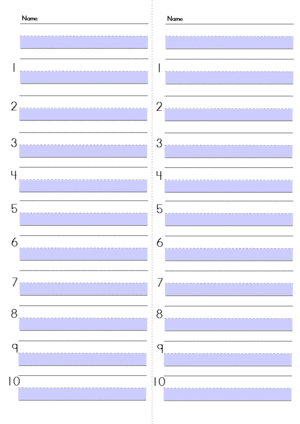
Click the following link to download this pdf Highlight paper spelling list2
We also recommend the use of raised line paper as the students can feel when their pencil touches the line.
Another fun strategy is cheering out spelling words. I LOVE this strategy as incorporates movement and doubles as a multi-sensory strategy for learning words. Students jump in the air with arms raised high for tall letters. For small letters, they stretch their arms off to the side and for decending letters they crouch down low.
Spacing Between Words
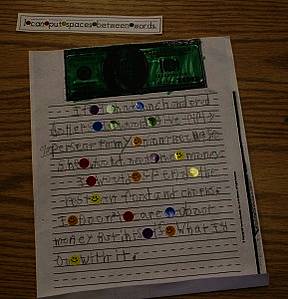
Another issue that affects legibility is not putting spaces between words. In April, I wrote a blog regarding a specific strategy that our fabulous OT, Lyzz, uses to help students with word spacing. Here’s the link to that post Teaching Students to Space Between Words
Case Consistently
Have you ever had a student write in all capital letters? Students who are not correctly using capitals or lowercase letters need direct instruction and practice. A reminder strip with simply upper- and lowercase letters on the desk may help.
Letter Formation
Students who are not forming letters correctly will need re-teaching of the correct stroke sequence. Using multi-sensory strategies such as writing letters in sand or shaving cream will help. Writing letters in the air prior to writing on the paper is a great strategy because it involves whole body movements (this is known as “air writing”). For a more structured program, the Handwriting Without Tears is a program which is highly respected and has proven effective in improving handwriting. In general, students need practice in writing the letters correctly. This will involve direct supervision when practicing writing as we do not want them practicing incorrect strokes (remember: only perfect practice makes perfect). It will take repeated practice writing letters correctly to reverse an old habit.
Handwriting Without Tears now has a new app. I absolutely love it!

It’s the Wet, Dry, Try App. It’s great because first the student is given a model of the correct letter strokes (voice too). Then he/she must wet the letter with the sponge, dry it with a towel and then write it again with the chalk (of course, all virtual).

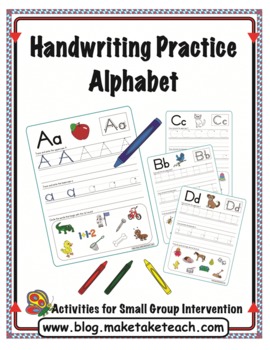
Handwriting practice worksheets also provided the extra practice needed when learning correct letter formation. These handwriting practice worksheets are available in my TpT store. I like to print a color copy and then laminate the pages (I use the heavier laminating sheets) so that they can be used over and over again.
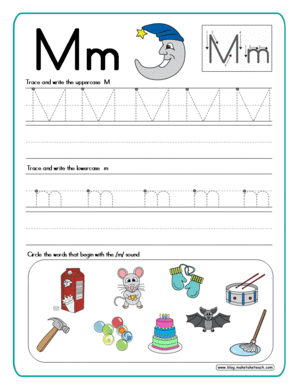
Click HERE or on the picture below to download handwriting practice pages for the letters of the alphabet.
Letter Reversals
Okay, I know this is a big one! So big in fact I wrote a blog devoted to just this issue. Here’s the link Why Students Reverse Letters
With a little bit (or quite a bit) of deliberate practice, our little writers can improve their penmanship.
How to Determine Extended School Year Services
Extended School Year Services (ESY)
As the school year comes to a close, parents may want to know if their children are entitled to Extended School Year Services (ESY). These services are provided to children with special needs that the school feels may lose his/her knowledge of what they learned over the summer months unless they are given added services during this time. The need for ESY services must be determined on an individual basis by the admission, review, and dismissal (IEP) committee.
Some students with disabilities have difficulty retaining skills during long school holidays and/or summer. If a student requires a significant amount of time to recoup mastered skills, then the IEP committee should discuss whether the student needs extended educational and/or related services during school breaks.
The determination of whether a child will receive ESY services will be made by the IEP committee; and the individualized education program (IEP) developed for ESY must include goals and objectives.
This program of services is paid for by the district and is of no cost to parents. Because of the nature of such services, all cases are determined on an individual basis, since these services will not be required by all students with disabilities. Such services are given only when the child meets certain criteria outlined by law and district policy.
Any decision regarding needed ESY programming must take into account the child’s history of significant regression and limited recoupment capability. In other words, the IEP Team must look backward and forward when considering the need for ESY programming.
In addition to significant regression (the significant loss of knowledge) and/or limited recoupment (the ability to gain back what is lost), courts have set forth other ESY criteria to be applied by a Team, as follows:
1.) the degree of the child’s impairment
2.) the parents’ ability to provide structure at home
3.) the child’s rate of progress
4.) the child’s specific behavior and/or physical problems
5.) the availability of alternative resources
6.) the child’s ability to interact with non-disabled children
7.) the specific curricular areas in which the child needs continuing attention
8.) the vocational and transition needs of the child
9.) whether the service requested is “extraordinary” rather than usual in consideration of the child’s condition.
Only when all factors are considered together by the child’s Team can a determination be made as to how much service will be offered.
When there is no previous record of a child’s substantial regression after a significant break in service, a Team should still consider the need for an ESY program if the following circumstances are present:
1.) there is lack of progress in meeting short-term objectives over two marking periods, resulting in little or no progress made over the school year
2.) there are significant regression/recoupment problems over short-term vacation periods or other breaks in the school year, and /or
3.) the unique nature of any specially designed instruction or related services due to the disability of the student requires such extended school year programming.
Since proposed ESY programming must take into account the probability of substantial regression, school districts should ensure that special education service providers maintain quantitative and qualitative data regarding the child, including anecdotal records on the rates of both learning and relearning, as well as a child’s attainment of IEP goals and objectives.
Download this Issue
Download a PDF file version of this issue of
NASET’s “How To” Strategies for Improving Handwriting – CLICK HERE
NASET’s “How To” Determine Extended School Year Services –CLICK HERE
To return to the main page for NASET’s “How To” Series – Click Here